
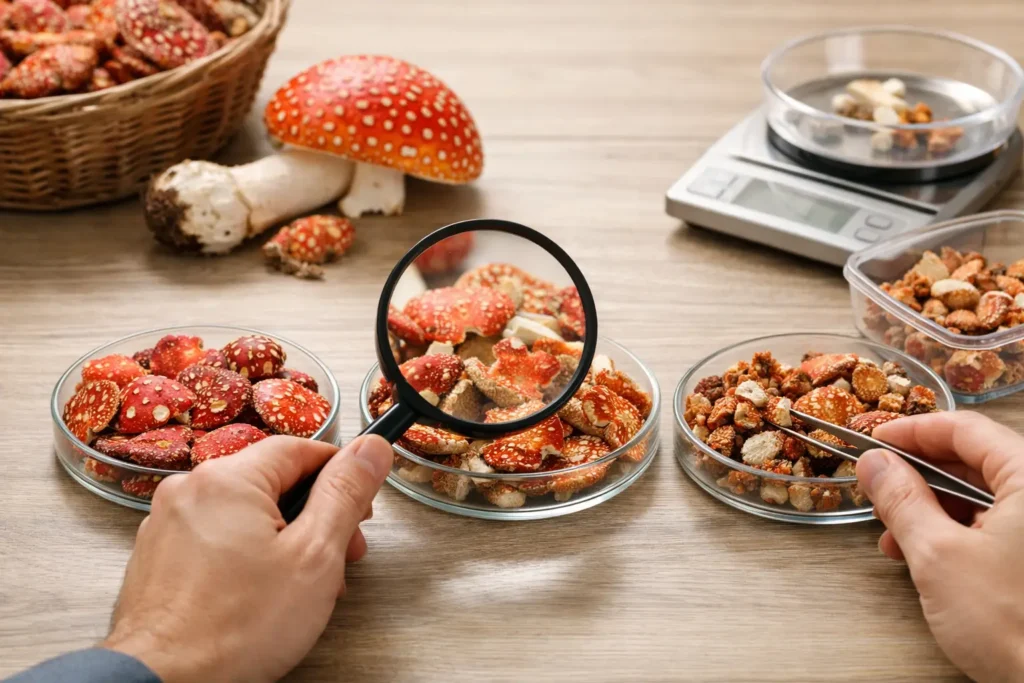
Amanita caps can look similar in a product photo while representing very different material. Species, cap integrity, drying quality, sorting standards, and source transparency all affect what you are actually buying. Knowing how to compare amanita cap grades means looking beyond labels such as “premium” or “select” and evaluating the details behind them.
For adult buyers interested in wild-sourced botanical material, grade is best understood as a seller’s sorting and quality framework, not a universal industry standard. A large, visually striking cap may be desirable for one collector, while another buyer may prioritize clean drying, accurate species identification, or a more uniform batch. The right comparison begins with the product category itself.
Start With Species, Not the Grade Name
“Amanita” is a genus, not a single product type. Amanita muscaria, Amanita pantherina, and Amanita regalis are botanically distinct wild mushrooms, and their appearance, availability, and market positioning can differ substantially. A grade label has little meaning until the species is clearly named.
A reputable listing should identify the mushroom at the species level. “Amanita caps” alone is too broad for a careful purchase decision. Look for the Latin name, clear product photos, and a description that distinguishes the item from functional mushroom powders, extracts, or capsules. Wild dried caps are raw botanical material with natural variation. They should not be presented as standardized supplements or treated as interchangeable with a repeatable wellness format.
Species identification is also a core quality signal because Amanita mushrooms can be confused with other mushrooms in the wild. Do not rely on home identification guides or visual assumptions to assess a product. Buy only from sellers that clearly define what they offer and maintain organized category separation.
How to Compare Amanita Cap Grades by Condition
Once species is established, examine the physical grade. Sellers may use terms such as whole caps, premium caps, select caps, mixed caps, pieces, or broken material. Those terms are not regulated, so the description matters more than the label.
Whole caps generally indicate that the cap remained intact through harvesting, drying, packing, and shipping. They can command a higher price because intact material is visually appealing and involves more careful handling. For collectors and buyers who value presentation, cap shape, surface color, and visible veil remnants, whole caps are often the preferred grade.
That said, intact does not automatically mean better in every respect. A whole cap can still be poorly dried, excessively aged, dirty, or inaccurately identified. Conversely, broken caps can come from the same well-handled batch as whole caps. Breakage is often a practical result of the natural fragility of dried mushrooms, especially during transit. It is not, by itself, evidence of low-quality material.
Inspect product descriptions and images for signs of careful processing: caps that appear dry rather than damp, clean rather than debris-heavy, and naturally varied rather than artificially uniform. Small chips, split edges, and some surface variation are normal in a dried wild product. Softness, visible moisture, unusual residue, or a musty presentation are reasons to be cautious.
Whole caps, mixed caps, and pieces
Whole-cap grades are typically selected for appearance and structural integrity. Mixed-cap grades may include different cap sizes or minor breakage, while pieces are usually fragments created during sorting and handling. These are different formats, not necessarily a simple ladder from good to bad.
If visual quality and display matter to you, choose a grade specifically described as whole or hand-selected. If your priority is obtaining accurately identified, properly dried botanical material at a more accessible price point, a mixed grade may be reasonable. The seller should state which format you are receiving rather than using photos of perfect whole caps to represent a package that mainly contains fragments.
Size Is a Sorting Attribute, Not a Guarantee
Cap size is frequently used in grade descriptions, but it should be interpreted carefully. Larger caps can be more visually impressive and may be harder to keep intact. That makes them attractive in premium listings. However, size can vary by species, growing conditions, maturity, and the location where a mushroom was collected.
A larger cap is not automatically cleaner, fresher, or more carefully dried. Likewise, smaller caps are not inherently inferior. If a seller groups material by size, that may indicate a more deliberate sorting process, but it does not replace information about the species, source, and condition of the batch.
Color requires the same level of restraint. Amanita caps naturally vary in tone. Age, weather exposure before harvest, drying method, and photography can all change how red, orange, brown, or yellow a cap appears. Do not use unusually vivid color as a standalone measure of quality. Natural color variation is expected in wild-sourced mushrooms.
Evaluate Drying and Storage Cues
Drying is one of the most consequential parts of handling wild mushroom material. The goal is stable, dry material protected from moisture and unnecessary damage. Product pages rarely reveal every step of a supplier’s process, but they can still provide useful clues about care and professionalism.
Clear photos should show dry caps with a crisp appearance, not wet-looking surfaces or condensation. Packaging should be appropriate for a dry botanical product and designed to limit crushing and moisture exposure. After delivery, keep the material sealed, cool, dry, and away from direct light. If a package arrives with signs of moisture, unusual odor, visible mold, or other damage, do not assume it is normal variation. Contact the seller before using or retaining the product.
Avoid treating age claims as a shortcut. “Fresh” can be misleading when the item is intentionally dried for storage. A better question is whether the material appears properly preserved and whether the retailer provides reliable fulfillment and product handling information.
Sourcing Transparency Separates a Grade From a Marketing Claim
Premium language is easy to print. Sourcing details are harder to fake and more useful to buyers. Look for a retailer that states whether Amanita products are wild-sourced and that distinguishes them from cultivated functional mushroom products.
Wild sourcing naturally introduces variation in cap shape, color, and size. That is part of the category. A dependable seller manages that variation through accurate species labeling, consistent sorting, honest photography, and product descriptions that explain what a grade includes. Transparency does not require revealing every supplier relationship or collection location. It does require enough information for a buyer to understand whether they are purchasing whole caps, a mixed grade, or fragments from a specified species.
For a specialty retailer, operational standards matter as much as visual standards. Secure checkout, clear inventory choices, fast processing, and responsive customer support do not change the mushroom itself, but they reduce avoidable uncertainty around the purchase. Mario’s Mushrooms approaches wild Amanita material as a distinct category, separate from processed functional formats where consistency and routine use are the central product expectations.
Do Not Confuse Lab Language With Standardization
Terms such as “lab-grade,” “tested,” or “premium” need context. In specialty botanical retail, these phrases may refer to handling standards, product screening, or quality-control processes. They do not automatically mean that a wild mushroom product has the same batch-to-batch uniformity as a standardized extract or capsule.
If testing is mentioned, look for clarity about what is being tested and why. Identification verification, contaminant screening, and handling controls are different claims from standardized constituent levels. A credible seller avoids vague promises and does not imply predictable outcomes from a naturally variable wild product.
This distinction is especially relevant when comparing Amanita caps with functional mushroom powders. A Lion’s Mane capsule may be selected for convenience and a repeatable format. Wild Amanita caps are selected for botanical specificity, natural form, and specialty sourcing. Comparing them by the same standard leads to poor buying decisions.
A Practical Comparison Before You Buy
When two Amanita listings have different grades or prices, compare the same details in the same order: species identity, whole-versus-broken format, visible condition, size sorting, drying cues, sourcing description, and seller transparency. Then consider whether the price difference reflects a feature you actually value, such as intact presentation or more selective sorting.
Be cautious with listings that rely on dramatic imagery but omit species names, grade definitions, or condition details. Also be cautious with claims that make wild mushroom material sound uniform, risk-free, or equivalent to a regulated supplement. Responsible product information is specific without overpromising.
The best grade is not always the largest cap or the most expensive listing. It is the grade that accurately describes the species and format, arrives in stable condition, and matches the reason you are choosing a wild botanical product in the first place.