
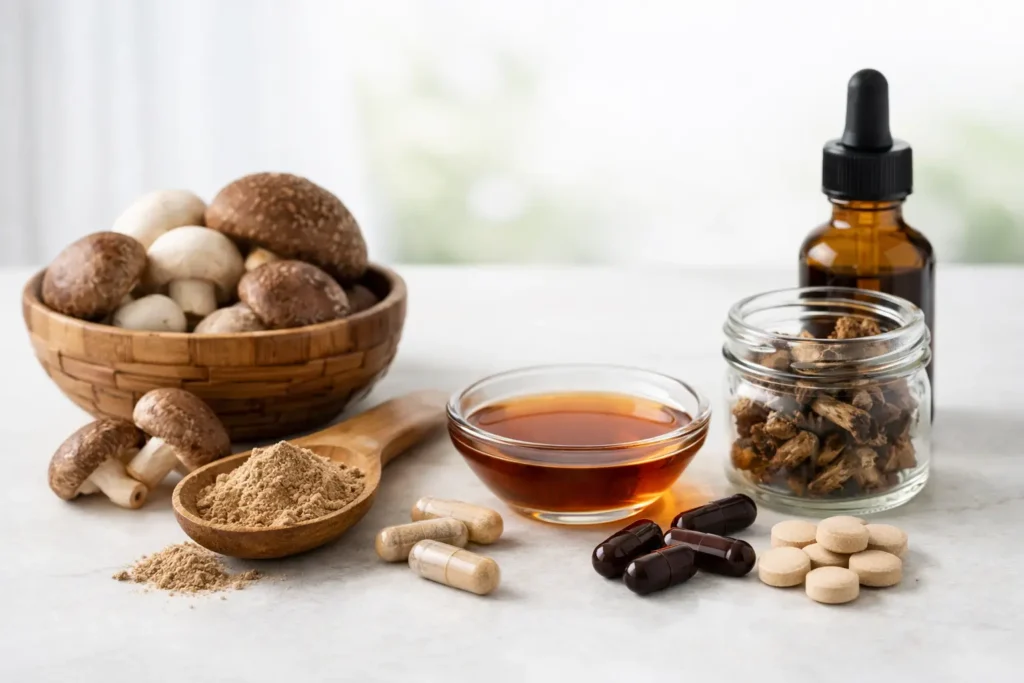
A mushroom product can be authentic, carefully sourced, and still vary from one piece or batch to the next. That is not necessarily a quality failure. It is often the reality of working with a natural material. Choosing the best mushroom formats for consistency starts with understanding what kind of consistency you mean: repeatable portions, stable ingredients, convenient routine use, or the unmistakably natural character of whole mushroom material.
For adult buyers comparing specialty Amanita products with functional mushroom supplements, format is one of the clearest signals. Dried wild caps preserve a raw botanical form. Powders and capsules are designed to make regular use easier to organize. Neither format is automatically better. They serve different expectations.
Consistency Has More Than One Meaning
“Consistent” is often used as a catchall, but buyers benefit from separating it into practical categories. Portion consistency refers to how easily you can measure the same amount each time. Batch consistency concerns how similar one production lot is to another. Routine consistency is about whether a format fits your schedule well enough to use reliably.
There is also material consistency. A whole, wild-sourced mushroom cap has natural differences in size, color, density, and composition. Those variations are part of its unmodified identity. A finely milled powder can be blended to distribute material more evenly through a container, while a capsule can provide a pre-measured amount of that powder or extract.
The right format depends on which of these factors matters most to you. If you value botanical individuality and direct visual inspection, whole dried material has a clear place. If you want a repeatable wellness routine with less measuring, processed functional formats usually make more sense.
Best Mushroom Formats for Consistency: A Practical Comparison
Capsules provide the most repeatable routine
Capsules are generally the strongest choice for buyers focused on convenience and portion control. Each capsule contains a defined quantity of the enclosed powder or extract, removing the daily need to scoop, weigh, or estimate. This is particularly useful for functional mushroom products intended to be incorporated into an established supplement routine.
Capsules also travel well, store cleanly, and limit exposure to moisture during normal use. For people who prefer a controlled, low-friction format, these details matter as much as the ingredient panel. A product that is simple to take is more likely to become a consistent part of a routine.
The trade-off is less direct contact with the raw material. You cannot see the particle size, color, or whole fruiting body characteristics in the same way you can with loose powder or dried caps. That is why clear product labeling matters. Look for a precise mushroom species, the type of material used, and whether the product is a powder, extract, or blend.
Powders balance control with flexibility
Functional mushroom powders offer a useful middle ground. They can be measured according to the product label, mixed into a preferred routine, and adjusted within the manufacturer’s stated serving guidance. They are often a good fit for customers who already use coffee, smoothies, or other daily beverages as a reliable anchor habit.
A well-prepared powder may offer more uniformity than intact mushroom pieces because material can be milled and blended before packaging. That does not mean every powder is interchangeable. Fruit body powders, mycelium-based powders, extracts, and combination formulas are distinct product types. Their sourcing, processing, and labeling should be evaluated accordingly.
Powders require a little more care than capsules. A level scoop is not the same as a weighed measurement, and settling can occur in a container over time. Keeping the package sealed, dry, and stored as directed helps maintain product condition. If precision is your top priority, a small scale can provide more repeatability than relying on volume alone.
Dried caps prioritize raw botanical character
Dried Amanita caps are best understood as whole or minimally altered wild botanical material, not as standardized supplements. Their appeal lies in visible authenticity: cap structure, natural coloring, and the individual characteristics of a wild-sourced mushroom. For experienced specialty mushroom buyers, that direct connection to the material is often the point.
However, whole dried caps are not the best choice when your primary goal is uniformity from one piece to another. Natural variation can result from growing conditions, maturity at harvest, drying, and the specific part of the mushroom. One cap may differ visibly from another even within the same species and lot.
That variability should be framed clearly rather than hidden behind supplement language. Amanita muscaria, Amanita pantherina, and Amanita regalis are distinct species, and whole dried material should be selected by buyers who understand that raw wild products are not interchangeable with functional capsules or standardized powders. Product identity, storage condition, and transparent category separation are more meaningful quality markers than a promise of identical appearance.
Extracts can improve ingredient standardization
When available in a functional mushroom lineup, extracts are often chosen for a different kind of consistency: controlled processing around identified compounds or extract ratios. This can make extracts attractive to shoppers who want a product format built around a defined specification rather than the full range of naturally occurring material in a whole mushroom.
Still, “extract” alone does not establish quality. The label should make clear which mushroom is used, whether fruiting bodies or mycelium are included, what extraction approach is represented, and what the stated serving contains. A vague proprietary blend provides less purchasing clarity than a product that identifies its ingredients and format directly.
An extract is also not automatically the right choice for everyone. Some buyers prefer a simple fruiting body powder because it remains closer to the whole mushroom profile. Others prioritize the operational consistency that a more processed format can offer. The better option is the one that matches your intended use and your preference for raw versus standardized material.
How to Choose the Right Format for Your Goal
Start with the routine, not the trend. If you want the simplest repeat-purchase format for regular functional mushroom use, capsules are usually the most controlled option. If you want flexibility in how a functional product fits into food or beverages, choose a powder from a clearly identified ingredient category. If your interest is centered on specialty ethnobotanical material and natural variation is part of the appeal, dried caps are the appropriate category to consider.
Then assess transparency. Reliable product selection begins with species identification, format disclosure, and clear separation between wild mushrooms and functional wellness products. A dried Amanita cap should not be presented as though it were a standardized Lion’s Mane capsule, and a capsule should not imply that it offers the same raw botanical experience as a whole cap. Mario’s Mushrooms keeps these categories distinct because the decision-making criteria are different.
Finally, consider storage and purchase cadence. Capsules and powders generally support predictable reordering because servings are easier to count. Dried caps may be purchased by weight or visual grade, which is more aligned with botanical collecting and specialty sourcing than with a calendar-based supplement routine. For any format, use intact packaging, follow storage directions, and check the product description before comparing one item to another.
What Consistency Cannot Replace
Standardized packaging and measured formats can improve organization, but they cannot replace informed buying. Functional mushroom products should be evaluated by their ingredient details and intended role in your routine, not by broad wellness promises. Wild-sourced Amanita material requires an even clearer distinction: it is a specialty botanical product with inherent natural variability, not a substitute for a standardized supplement.
The strongest purchase decision is usually the least complicated one. Choose capsules when repeatable portions are the priority, powders when flexibility matters, and dried caps when you want to evaluate authentic whole mushroom material on its own terms. A format that matches your expectations from the start will feel more consistent long after the first order.