
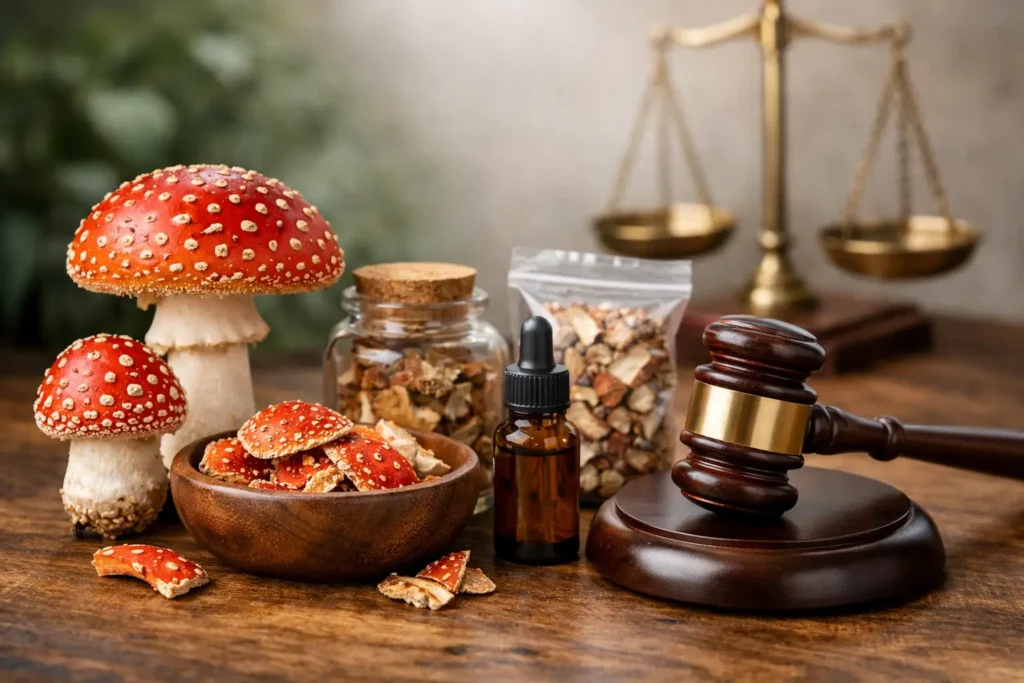
A dried Amanita cap, a bright gummy, and a bottle of mushroom capsules may all use the word “mushroom,” but they do not carry the same legal or regulatory questions. Are amanita products legal? In many parts of the United States, Amanita muscaria and related species are not federally scheduled controlled substances. That does not mean every Amanita product is legal to sell, ship, market, or consume in every location.
For buyers, the practical issue is product category. Raw, identifiable botanical material is evaluated differently from a processed edible, a concentrated extract, or a product marketed with drug-like claims. The details matter, especially when a label uses broad language such as “mushroom blend” without clearly identifying what is inside.
Are Amanita Products Legal Under Federal Law?
At the federal level, Amanita muscaria, Amanita pantherina, and Amanita regalis are generally not listed as controlled substances under the U.S. Controlled Substances Act. Their better-known compounds, muscimol and ibotenic acid, are also not generally scheduled in the same way as psilocybin or psilocin.
That distinction is central. Amanita mushrooms are not psilocybin mushrooms, and they should not be described or treated as though they are. They have different naturally occurring compounds, different effects, different risks, and a different legal history.
Still, “not scheduled” is only one part of legality. Federal rules can also apply through food, dietary supplement, consumer protection, shipping, and product-labeling laws. A retailer cannot assume that an ingredient’s nonscheduled status permits any format, any claim, or any presentation.
For example, a plainly identified dried mushroom cap sold as raw botanical material presents a different regulatory profile than a fruit-flavored chew marketed for mood, sleep, intoxication, or medical outcomes. The latter may trigger closer scrutiny from food and drug regulators, particularly if it contains undisclosed ingredients or makes claims that position it as a treatment.
Product Format Changes the Legal Question
The most useful way to assess an Amanita product is to start with what it actually is, not what its marketing suggests.
Raw dried caps and wild botanical material
Dried Amanita caps are typically sold as whole or broken wild-sourced mushroom material. The product is recognizable, species-specific, and relatively easy for an informed buyer to distinguish from a conventional supplement. It is still important to verify the botanical identity, country of origin, handling standards, and whether the seller clearly states what is being offered.
Raw material is not automatically “approved” for food use or dietary supplementation simply because it is natural. However, transparent botanical presentation avoids some of the confusion created by heavily processed products that combine extracts, flavor systems, and proprietary blends.
Gummies, chocolates, beverages, and other edibles
Amanita-branded edibles deserve more caution. The label may name Amanita while the product contains other compounds, synthetic ingredients, or a blend that does not clearly identify the active components. U.S. regulators have issued warnings and recalls involving certain mushroom edibles after reports of illness and testing that found ingredients not clearly communicated to consumers.
This does not mean every mushroom gummy is unlawful. It means the category has a higher verification burden. A clear ingredient panel, lot information, manufacturer identity, and conservative labeling are practical signs of a more controlled product. Vague “proprietary mushroom blend” language is not a substitute for transparency.
Extracts and supplement-style products
Extracts create a separate set of questions because concentration and intended use matter. A product positioned as a dietary supplement may be subject to federal requirements concerning ingredient identity, manufacturing practices, label structure, and health claims. Sellers should not present an Amanita product as diagnosing, treating, curing, or preventing a disease.
Functional mushroom products such as Lion’s Mane are often marketed in standardized powders or capsules designed for repeatable wellness routines. They should not be confused with wild Amanita material merely because both come from fungi. Clear category separation helps customers understand whether they are purchasing a raw specialty botanical or a processed functional format.
State and Local Rules Can Be More Restrictive
Federal scheduling is not the final word. States, counties, cities, and campus jurisdictions can adopt rules that are more restrictive than federal law. Some locations regulate particular psychoactive plants and fungi through local ordinances, while others may apply food or consumer-safety rules in ways that affect retail sale.
The result is not a simple national yes-or-no answer. An Amanita product may be available for shipment from one state while a buyer’s local rules, age restrictions, or intended use create a different outcome. Online availability is not proof that a product is permitted where you live.
Before ordering, buyers should check current state and local rules using official government sources or speak with a qualified attorney when the stakes are significant. This is particularly relevant for travel. Carrying a product across state lines, into tribal jurisdictions, onto federal property, or through an airport can add layers of regulation that do not apply to keeping a product at home.
Canada Has Its Own Regulatory Framework
Canadian customers should avoid assuming that U.S. availability answers the question for Canada. Amanita species may not be treated as controlled drugs in the same manner as scheduled substances, but product classification, import requirements, food rules, provincial enforcement, and health-product claims can still affect what may be sold or shipped.
A raw dried specimen, an edible, and a capsule marketed for a health purpose can each fall into different compliance conversations. Cross-border ordering adds customs considerations as well. Buyers should confirm the current rules for their province and the specific product format before placing an order.
What Legal Availability Does Not Mean
A legal status question is often mistaken for a quality or safety question. They are separate.
Legal availability does not confirm species identity, potency, suitability, or safe handling. Wild mushrooms naturally vary by growing region, season, maturity, and processing. Amanita muscaria, Amanita pantherina, and Amanita regalis should not be treated as interchangeable products. Species-level accuracy is a baseline requirement, not a premium extra.
It also does not mean a product is appropriate for everyone. People who are pregnant or nursing, managing a medical condition, taking prescription medications, or considering use before driving or operating equipment should take particular care and consult a qualified healthcare professional where appropriate. Children and pets should never have access to specialty mushroom products.
Responsible sellers avoid turning legal ambiguity into hype. Claims such as “legal high,” “safe psychedelic,” or “identical to psilocybin” are not reliable product education. They flatten meaningful differences between species, formats, chemistry, and individual response.
A Better Buyer Checklist
When evaluating whether an Amanita product is appropriate to purchase in your area, start with the product label and work outward. Confirm the exact species rather than accepting a generic mushroom name. Look for a clearly named seller, a complete ingredient statement, and a format that matches the listing description.
Then consider the product’s presentation. Whole dried caps should be identified as such. A gummy, chocolate, or beverage should disclose all ingredients rather than relying on mystery-blend language. Any product making dramatic wellness or therapeutic promises deserves extra skepticism, regardless of its apparent legal status.
Finally, check the rules where the product will be delivered and used. This is more useful than relying on social posts, search snippets, or a retailer’s general statement. Regulations and enforcement priorities can change, and local rules can be narrower than broad federal guidance.
For specialty mushroom buyers, the strongest standard is clarity: know the species, know the format, know the ingredients, and know the rules that apply where you are. That approach supports better purchasing decisions long before checkout.