
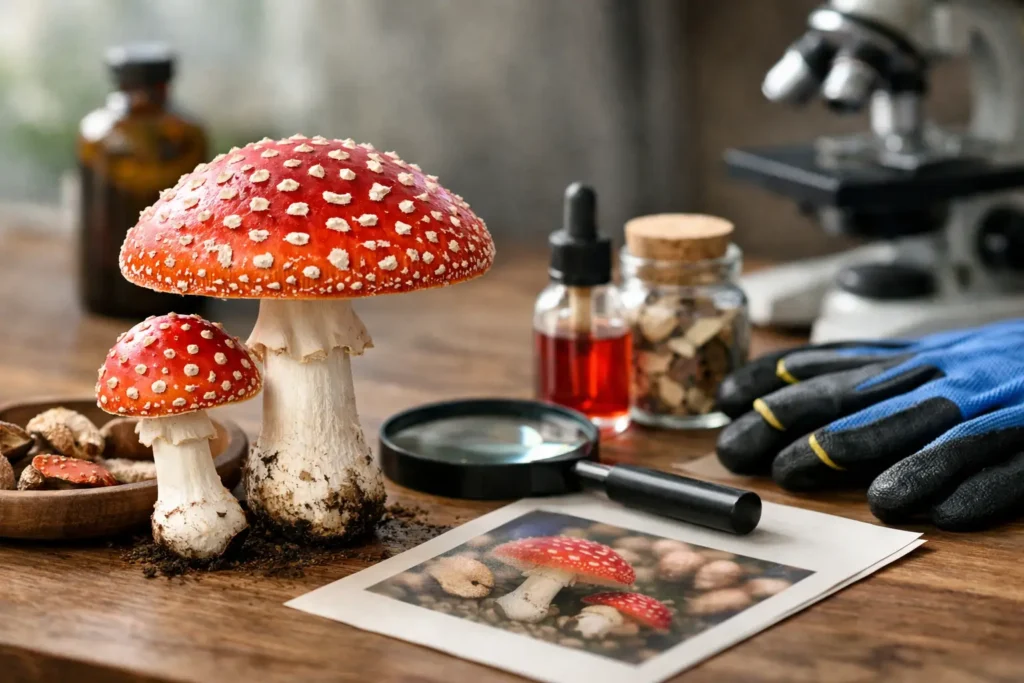
Wild Amanita caps are not interchangeable with functional mushroom powders, and that distinction should guide every purchase decision. This amanita safety information is designed for adults who want a clear view of the material, the species-level differences, and the precautions that belong around any wild-sourced botanical product.
Amanita muscaria, Amanita pantherina, and Amanita regalis are botanically distinct wild mushrooms with variable natural chemistry. They are not standardized wellness supplements, and dried caps should not be treated as a predictable equivalent to a capsule, extract, or food ingredient. Responsible handling begins with accurate labeling, realistic expectations, and a firm rule: if there is uncertainty about identity, condition, or exposure, do not guess.
Amanita Safety Information Starts With Species Identity
The name “Amanita” covers a large genus, including some of the world’s most dangerous poisonous mushrooms. A product label that says only “Amanita” does not provide enough information for an informed buyer. The species name matters, as does whether the material is whole, dried, powdered, wild-harvested, or processed.
Amanita muscaria is commonly recognized by its red to orange cap and pale universal-veil remnants, though appearance varies substantially by region, weather, age, and handling. Amanita pantherina is generally associated with a brown cap and pale warts. Amanita regalis commonly has a brown to yellow-brown appearance. Visual descriptions can support a properly labeled product, but they are not a safe method of mushroom identification in the field.
Wild look-alikes are a serious issue. Some Amanita species contain amatoxins, which can cause severe delayed liver injury and may be life-threatening. Others contain different toxic compounds with different symptom patterns. Never assume that a mushroom is safe because it resembles a familiar image online, grows near a known species, or has a cap color you associate with Amanita muscaria.
For buyers, the practical standard is simple: purchase only material that is clearly categorized by species and source. Do not mix unidentified foraged mushrooms into a labeled product, and do not rely on informal identification groups for a medical safety decision.
Wild Caps and Functional Mushrooms Serve Different Categories
A dried wild Amanita cap is a raw botanical material. Its shape, color, density, and naturally occurring compounds can vary from cap to cap and season to season. That natural variability is part of the category, but it also means the material does not offer the consistency expected from a standardized functional mushroom format.
Functional products, such as clearly labeled Lion’s Mane powders or capsules, are typically selected for routine-use convenience and repeatable serving information. They should still be used according to their labels, but they occupy a different product category from wild Amanita material. Confusing these formats is one of the most avoidable safety errors in specialty mushroom purchasing.
Terms such as “natural,” “wild,” “premium,” or “dried” do not mean a product is appropriate for everyone. They describe sourcing or format, not individual suitability. Anyone seeking treatment for a condition, managing symptoms, or trying to replace prescribed care should speak with a qualified healthcare professional rather than self-directing with a wild mushroom product.
Why Potency Cannot Be Assumed
Amanita muscaria, pantherina, and regalis can contain muscimol and ibotenic acid, among other naturally occurring compounds. Levels vary with species, growing environment, individual mushroom, maturity, storage history, and other factors. Drying changes the material, but it does not turn a wild mushroom into a standardized or risk-free product.
That variability creates a meaningful safety issue. One cap may not reflect another cap from the same batch, and a prior experience does not reliably predict a future one. Product weight alone also cannot fully describe the active chemical profile of a wild mushroom.
Amanita pantherina is often regarded as requiring particular caution because it may have a different and potentially stronger chemical profile than Amanita muscaria. Amanita regalis should likewise be treated as its own species, not as a simple substitute based on appearance or name. Species-specific labeling is a baseline, not a guarantee of uniform effects.
Avoid combining Amanita products with alcohol, sedatives, sleep medications, benzodiazepines, opioids, or other substances that affect alertness or the central nervous system. The interaction risk may be difficult to predict, and impaired judgment can make an otherwise manageable situation more dangerous. Do not drive, operate machinery, supervise children alone, or make safety-critical decisions after exposure.
Who Should Avoid Amanita Products
Wild Amanita material is not appropriate for children or adolescents. Keep it inaccessible to minors and treat it with the same storage discipline used for any potentially toxic botanical or medication.
Pregnant or breastfeeding individuals should avoid Amanita products because safety data are insufficient. People with seizure disorders, significant liver or kidney disease, a history of severe psychiatric symptoms, or sensitivity to psychoactive substances should also avoid use unless a qualified clinician with relevant knowledge advises otherwise.
Extra caution is warranted for anyone taking prescription medications, especially medicines that affect mood, sleep, anxiety, pain, cognition, or seizure threshold. A clinician or pharmacist can review a medication list for known concerns, although the limited research and natural variability around Amanita products may mean that a definitive interaction assessment is not possible.
Storage and Product Control Matter
Dried caps should remain in their original labeled packaging until needed for inspection or use. Store them in a cool, dry place away from direct light, humidity, food preparation surfaces, pets, and children. Moisture can degrade product condition and encourage contamination, while loose or unlabeled material creates an obvious identification hazard.
Do not transfer caps into a candy jar, snack container, or any package that could be mistaken for food. If a package is torn, damp, moldy, has an unusual odor, or cannot be confidently identified, do not use it. Contact the seller for product-specific guidance or dispose of it in a way that prevents accidental access by people and animals.
Maintain separation between wild Amanita products and everyday functional supplements. This is especially useful in households where multiple mushroom products are stored together. Clear labels, original packaging, and a dedicated storage area reduce preventable mix-ups.
Recognize Symptoms and Act Early
Potential effects from Amanita exposure can include nausea, vomiting, dizziness, confusion, agitation, drowsiness, impaired coordination, unusual perceptions, or loss of consciousness. Symptoms and timing can differ by species, material, and individual. Serious poisoning may not always look dramatic at first, particularly when the mushroom’s identity is uncertain.
Seek immediate professional guidance after an unintended ingestion, an exposure involving a child or pet, or symptoms that feel concerning or unusual. In the United States, call Poison Control at 1-800-222-1222 for prompt case-specific guidance. In Canada, contact the poison center serving your province or territory. Call emergency services immediately for severe symptoms or if a person cannot be safely monitored.
The following signs require urgent emergency evaluation:
- Trouble breathing, chest pain, seizures, fainting, or unresponsiveness
- Severe confusion, extreme agitation, hallucinations, or inability to stay awake
- Repeated vomiting, inability to keep fluids down, or signs of dehydration
- Any possible ingestion of an unidentified wild mushroom
If possible, retain the original packaging and any remaining material for identification. Do not induce vomiting unless Poison Control or emergency clinicians specifically direct you to do so. Do not attempt to manage a serious reaction with home remedies, more substances, or advice from social media.
A Clear Standard for Responsible Purchasing
Specialty mushroom buyers often value wild authenticity precisely because it is not a mass-produced, uniform format. That value comes with a responsibility to respect species identity, natural variation, and the line between an ethnobotanical product and a routine wellness supplement.
Choose transparent labeling, keep material secured, avoid casual mixing with other substances, and treat uncertainty as a reason to pause rather than proceed. The most informed Amanita purchase is one made with clear category awareness and a plan for safe storage, careful handling, and prompt professional help if an exposure does not go as intended.