
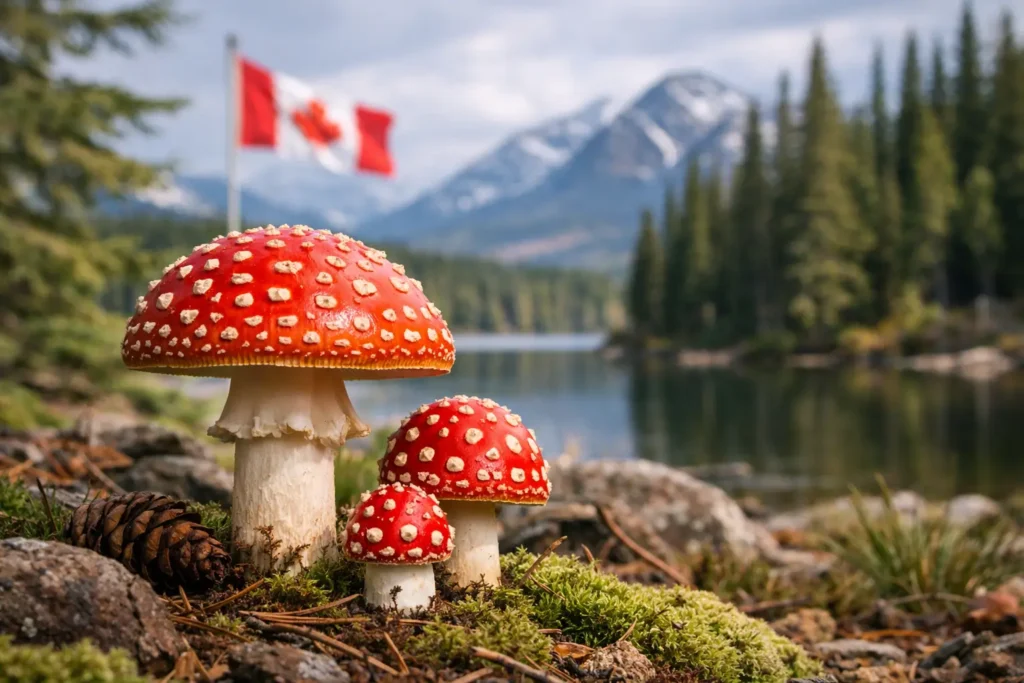
A dried Amanita cap can be legally different from a regulated drug, a food product, and a wellness supplement – even when the same mushroom is involved. So, are amanita mushrooms legal in Canada? In general, Amanita species such as Amanita muscaria, Amanita pantherina, and Amanita regalis are not federally scheduled as controlled substances in the same way as psilocybin-containing mushrooms. That does not create a blank-check market. Product format, marketing, import status, provincial rules, and intended use can all affect the practical legal picture.
For buyers, the useful distinction is simple: legality is not the same as suitability, safety, or approval for a specific use. Premium wild-sourced mushroom material should be identified accurately, sold transparently, and understood on its own terms.
Are Amanita Mushrooms Legal in Canada Under Federal Drug Law?
Canada’s Controlled Drugs and Substances Act regulates the possession, production, sale, and distribution of listed controlled substances. Psilocybin and psilocin are scheduled substances, which is why the legal treatment of psilocybin mushrooms is very different from that of Amanita mushrooms.
The primary compounds associated with Amanita muscaria and related species are muscimol and ibotenic acid. They are not generally listed as controlled substances under the federal drug schedules that govern psilocybin and psilocin. As a result, naturally occurring Amanita mushrooms are generally not prohibited solely because they contain muscimol or ibotenic acid.
That is the core reason dried Amanita caps may be offered in Canada as specialty botanical or ethnobotanical material. It is also why shoppers should not assume that every mushroom sold in a similar-looking package has the same legal status. Species matters. Chemical profile matters. Product claims matter.
Legal to Possess Is Not the Same as Approved to Consume
The most common point of confusion is treating federal controlled-drug status as the only rule that applies. It is not.
A raw wild mushroom can fall outside controlled-drug scheduling while still raising separate questions under food, consumer protection, health-product, import, and labeling rules. A product marketed as a food, dietary supplement, or therapeutic product enters a more regulated category than a clearly described raw botanical specimen.
For example, making disease-treatment claims can change how regulators view a product. Claims that a mushroom cures anxiety, treats addiction, manages a medical condition, or produces a predictable therapeutic outcome are not casual product descriptions. In Canada, products marketed with health claims may be subject to requirements that do not apply in the same way to unprocessed wild-harvested material.
This is why category clarity matters. Raw dried caps are not interchangeable with a standardized functional mushroom capsule. The former is natural material with normal biological variation. The latter is typically formulated for repeatable serving sizes and regular-use positioning. Treating both categories as if they carry the same legal, quality, or consumer-use expectations creates unnecessary confusion.
What Canadian Buyers Should Look For
A lawful-looking listing is not automatically a well-run listing. The quality of the seller’s information is often the clearest practical signal for specialty mushrooms.
Start with species identification. Amanita muscaria, Amanita pantherina, and Amanita regalis are distinct species, not interchangeable names. Their natural compound profiles can vary, and pantherina is commonly regarded as more potent than muscaria. A responsible retailer should identify the material specifically rather than relying on vague labels such as “magic mushroom” or “legal psychedelic.”
Next, assess how the product is categorized and described. Clear distinctions between dried wild caps, powders, extracts, and functional mushroom supplements help buyers understand what they are actually purchasing. A seller should not blur a raw Amanita product into a conventional wellness supplement or make medical promises that the product category cannot support.
Finally, consider basic operating standards: clear product information, secure checkout, responsive order handling, and transparent shipping terms. These details do not decide legality on their own, but they do help separate organized specialty retailers from sellers who rely on ambiguity.
Provincial Rules and Local Context Still Matter
Federal scheduling is only one layer. Provinces, territories, municipalities, retailers, and event venues may have their own policies concerning product sales, public consumption, impaired behavior, business licensing, or nuisance enforcement.
There is no universal provincial rule that turns all Amanita mushrooms into controlled drugs. Still, local enforcement and consumer-product rules can vary by context. A product available through an online specialty retailer may not be welcome in a food service setting, a public market, or a venue with its own prohibited-substance policy.
Canadian buyers should also remember that impaired driving laws are broader than the legal status of a product. Driving while impaired by drugs is illegal. The fact that a substance is not federally scheduled in the same category as psilocybin does not make impaired operation of a vehicle acceptable or lawful.
Importing Amanita Products Can Add Complexity
Cross-border ordering deserves extra care. A product that can be possessed or sold in Canada may be treated differently at another country’s border, and customs authorities can examine botanical material for multiple reasons, including agricultural restrictions, labeling concerns, product classification, and prohibited ingredients.
For Canadian customers, purchasing from a retailer that processes orders within Canada can reduce some of the uncertainty associated with international shipping. It does not remove the buyer’s responsibility to understand the product, but it avoids assuming that foreign regulations, customs decisions, and domestic rules will align.
The reverse is also true for U.S. buyers considering Canadian sellers. Laws and enforcement priorities can differ by state, and a Canadian product listing should not be read as a legal opinion for another jurisdiction.
Amanita Safety Is a Separate Question From Legality
Amanita mushrooms deserve caution precisely because they are not ordinary culinary mushrooms and are not standardized pharmaceuticals. Muscimol and ibotenic acid can produce significant and unpredictable effects. Individual response can vary with species, mushroom chemistry, preparation, amount, body size, medications, health status, and prior experience.
Misidentification is another serious concern. The Amanita genus includes species that are dangerously toxic or potentially fatal. Wild harvesting without advanced identification knowledge carries real risk. Buyers should never rely on a photograph, a casual description, or a common name to identify a mushroom intended for any use.
Avoid combining Amanita products with alcohol, sedatives, or other substances that may intensify impairment. People who are pregnant or breastfeeding, managing a medical condition, taking prescription medication, or dealing with a mental-health concern should speak with a qualified healthcare professional before considering any psychoactive botanical. Keep all mushroom products secured away from children and pets.
A product’s legal availability should never be presented as proof of safety. The more specialized the botanical, the more useful it is to choose accurate labeling, reliable sourcing, and restrained product claims over hype.
The Bottom Line for Amanita Buyers in Canada
For most adults, the direct answer is that Amanita muscaria and related Amanita mushrooms are generally legal to possess and sell in Canada because they are not federally scheduled like psilocybin mushrooms. But that answer has boundaries. Selling a mushroom as raw ethnobotanical material is different from marketing it as a food, a regulated health product, or a treatment for a medical condition.
Rules can change, enforcement can be context-specific, and product quality is never guaranteed simply because an item is available online. For a current legal concern involving a specific product, province, or import situation, consult an appropriate legal or regulatory professional.
The smarter purchase decision is not just asking whether a mushroom is legal. It is asking whether the species is clearly identified, the category is honestly presented, the seller is transparent, and the product is being approached with the caution that a specialized wild botanical requires.