
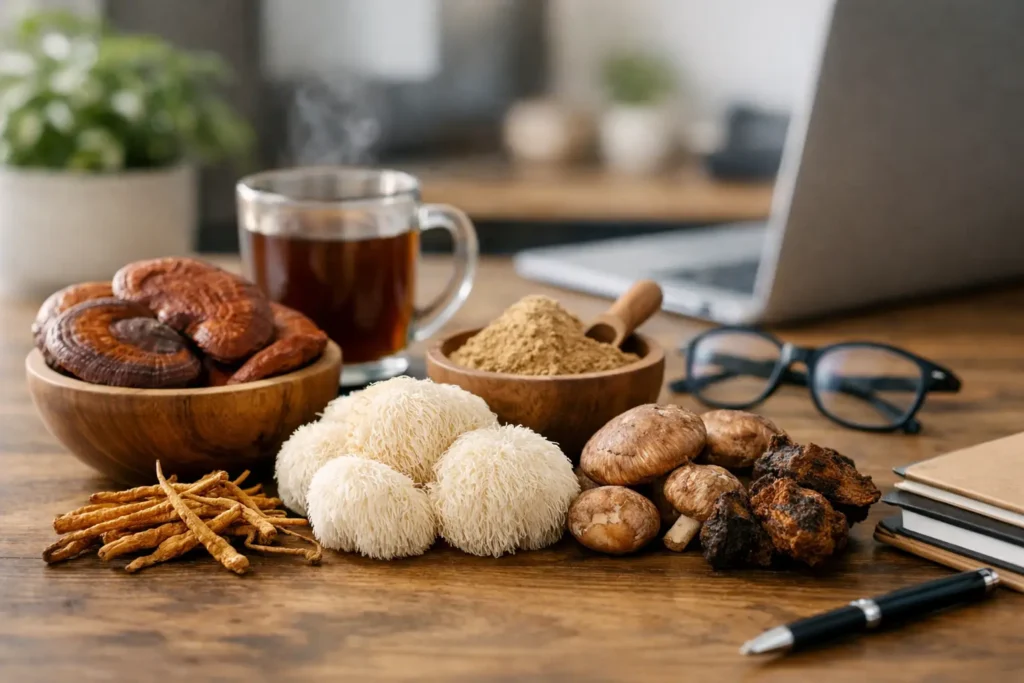
A focus supplement should fit a repeatable routine, not promise a dramatic overnight shift. The top functional mushrooms for focus are best viewed as distinct botanical tools: some are chosen for cognitive support, some for steady energy, and some for stress management that can indirectly improve concentration. The right choice depends on what is getting in the way of your attention in the first place.
For most buyers, Lion’s Mane is the clear starting point. But it is not the only functional mushroom worth considering, and product format matters as much as the species name on the label. A fruit body powder, a mycelium-heavy blend, and a standardized extract can perform very differently in a daily routine.
What “focus” actually means in a mushroom routine
Focus is often treated as one problem, but it has several causes. You may need more mental clarity during reading or desk work. You may have adequate concentration but poor energy in the afternoon. Or your attention may be scattered because stress, poor sleep, and overstimulation are competing for it.
Functional mushrooms are not stimulant replacements. They generally do not work like coffee, prescription medication, or a fast-acting nootropic. Their value is usually in consistent use, modest support, and a lower-intensity approach to daily wellness. Set expectations accordingly: evaluate a product over several weeks, while keeping sleep, hydration, food intake, and caffeine habits reasonably stable.
Top functional mushrooms for focus
Lion’s Mane: the primary cognitive-support option
Lion’s Mane, known botanically as Hericium erinaceus, is the functional mushroom most closely associated with memory, mental clarity, and cognitive wellness. It is a natural first choice for people building a study, creative-work, or office-focus routine.
Its appeal is not that it creates a sudden “switched on” feeling. A quality Lion’s Mane product is generally used for steady, regular support. Many customers take it in the morning with coffee, tea, or breakfast, though capsules can be more practical for travel and tightly scheduled days.
When comparing Lion’s Mane products, identify the material used. Fruit body powders offer a straightforward whole-mushroom format. Extracts are processed to concentrate selected mushroom compounds and can offer a more consistent serving profile. Neither format is automatically superior for every buyer, but the label should clearly state what it contains. Vague proprietary blends make meaningful comparison difficult.
For a simple daily cognitive routine, Lion’s Mane is usually the most direct and practical selection.
Cordyceps: for focus when energy is the limiting factor
Cordyceps is often chosen for stamina, exercise support, and sustained daily energy. It may be a better fit than Lion’s Mane when the real barrier to concentration is physical fatigue, low drive, or an afternoon energy drop.
This distinction matters. A person who feels mentally busy but physically depleted may not need a stronger cognitive-oriented formula. They may benefit more from a routine that supports steadier energy without adding another large dose of caffeine.
Cordyceps is commonly used before active workdays, workouts, or demanding periods that require both physical output and alertness. It can pair well with Lion’s Mane, but start with one product first if you are new to functional mushrooms. That makes it easier to assess tolerance, timing, and whether the product is actually helping your routine.
Reishi: for focus disrupted by stress
Reishi is not a conventional focus mushroom. It is more often selected for relaxation, balance, and evening wellness. Still, it earns a place in the conversation because stress can be one of the biggest threats to clear attention.
If your workday is marked by tension, racing thoughts, or difficulty winding down at night, a calming routine may have more long-term value than chasing another energizing product. Reishi is therefore often better placed later in the day rather than before a presentation, exam, or high-output task.
The trade-off is obvious: Reishi is less suitable for people seeking a noticeable daytime lift. Consider it a support option for the conditions around focus, especially rest and stress management, rather than a direct concentration tool.
Chaga: for foundational daily wellness
Chaga is valued for its antioxidant profile and broad wellness positioning. It is not the strongest direct candidate for cognitive performance, but some buyers include it in a daily mushroom routine because they prefer a foundational, whole-body approach.
Choose Chaga when your priority is general wellness and you want focus support to come from a broader routine rather than a narrowly targeted formula. It is also a useful example of why mushroom blends need scrutiny. A blend containing Lion’s Mane, Chaga, Reishi, and Cordyceps may look comprehensive, but it can make it harder to know which mushroom is doing what and whether each ingredient is present at a meaningful amount.
Turkey Tail: valuable, but not a focus-first choice
Turkey Tail is widely used in functional mushroom routines centered on immune support and gut health. It has a strong place in the broader category, but it is not a primary choice for focus.
That does not make it a poor product. It simply reinforces the need to buy by intended use rather than by popularity. If concentration is the immediate goal, Lion’s Mane or a Lion’s Mane and Cordyceps approach is usually more aligned with the outcome you are trying to support.
Choose the format before you choose the label
Functional mushroom products are sold as loose powders, capsules, tinctures, gummies, coffees, and blends. Convenience has value, but it should not replace product transparency.
A plain powder can be ideal for buyers who want a minimally complicated daily format and do not mind measuring servings. Capsules are efficient, portable, and easier to use consistently. Extracts may appeal to customers looking for concentrated, standardized products with clear compound information. The best format is the one you can take regularly without creating friction in your day.
Look for a label that identifies the mushroom species, the plant part or fungal material used, serving size, and any extraction details. For fruiting-body products, the product should say so directly. If a formula uses mycelium, that should also be clearly disclosed. Mycelium is not inherently a disqualifier, but it is a different material, and buyers should be able to make that decision with accurate information.
Avoid assuming that a large milligram number means a better product. A high total weight can include fillers, grain-based substrate, or a long list of ingredients at very small amounts. Clear sourcing and precise categorization are better quality signals than oversized front-label claims.
A practical starting routine
Start with Lion’s Mane if your goal is clearer, more consistent mental performance during knowledge work, study, or creative tasks. Take the labeled serving daily for several weeks, preferably at the same time each day. Keep a brief note on concentration, energy, sleep, and digestive tolerance rather than relying on a single good or bad day.
If energy remains the issue, consider adding Cordyceps after you have established how Lion’s Mane works for you. If stress or poor sleep is the bigger pattern, a separate evening-focused Reishi routine may be more logical than increasing daytime products.
Do not introduce several new supplements at once. Mushroom formulas can be straightforward, but a layered stack makes it difficult to identify what is useful, unnecessary, or poorly tolerated.
Keep functional and wild mushrooms in separate categories
Functional mushroom powders and capsules are designed for repeatable wellness routines. They should be evaluated by species, processing method, serving clarity, and consistency.
Wild-sourced Amanita products belong in a separate category. Amanita muscaria, Amanita pantherina, and Amanita regalis are not functional focus supplements, and their raw dried caps should not be selected as substitutes for Lion’s Mane, Cordyceps, or other standardized daily-use products. Responsible purchasing starts with knowing whether you are choosing a processed functional product or unmodified wild botanical material.
Adults who are pregnant, nursing, managing a medical condition, preparing for surgery, or taking medication should speak with a qualified healthcare professional before starting a mushroom supplement. Stop use if an adverse reaction occurs.
The strongest focus routine is usually the least complicated one: a clearly labeled Lion’s Mane product, taken consistently, with Cordyceps considered only when steady energy is part of the equation. Choose transparent functional formats, give them enough time to assess, and let the product category match the purpose.