
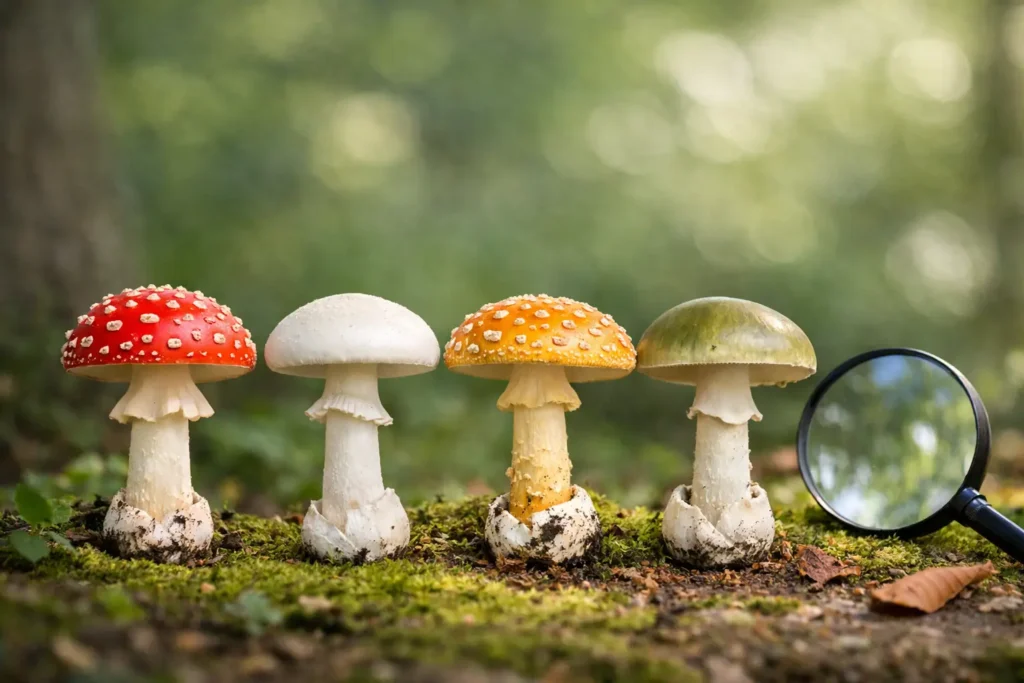
A red cap with white spots may be the image most people associate with Amanita, but amanita species differences go far beyond a familiar color pattern. Within one genus, mushrooms can differ in appearance, natural chemistry, habitat, seasonal timing, and risk profile. Those differences matter when evaluating dried caps, researching ethnobotanical material, or simply trying to understand why an Amanita muscaria product is not interchangeable with Amanita pantherina or Amanita regalis.
The first rule is simple: common names, photos, and cap color are not enough to identify a wild Amanita. This is a genus that includes species associated with serious and potentially fatal poisoning. Educational comparison can help buyers understand product categories, but it is not a substitute for expert identification or medical advice.
Why Amanita Species Differences Matter
Amanitas are wild mushrooms, not a single uniform ingredient. Even species that are commonly grouped together in specialty mushroom conversations have their own morphology and naturally variable profiles. Origin, maturity, weather, handling, and the portion of the mushroom collected can all affect what a dried product looks like from batch to batch.
That makes species-level labeling a quality issue, not a marketing detail. A clearly identified botanical category gives customers a more accurate basis for understanding what they are viewing. It also separates wild-sourced Amanita material from functional mushroom powders or capsules, which are generally processed and presented for routine, standardized use.
For specialty buyers, the practical question is not which Amanita is “best.” It is whether a product is accurately categorized, visibly distinct from other species, and presented with appropriate safety boundaries.
Amanita Muscaria: The Recognizable Reference Point
Amanita muscaria is the best-known species in the group. In its classic form, it has a red to orange-red cap with pale, wart-like veil remnants. It is widely associated with birch, pine, spruce, and other trees in temperate and boreal regions. However, appearance varies substantially by region and variety. Caps can fade with rain, age, sun exposure, or drying, and the white remnants can wash away.
When specialty retailers use the term fly agaric, they are usually referring to A. muscaria. It is the reference point against which many consumers compare other wild Amanita caps. Still, a recognizable visual identity should not be mistaken for an identification method. A red-orange cap alone does not establish species, origin, or suitability for any purpose.
A. muscaria is also distinct from wellness mushrooms such as Lion’s Mane. Lion’s Mane products are commonly sold as powders, extracts, or capsules intended to fit a consistent daily format. Wild A. muscaria caps remain botanically variable material, with a different product logic and a different level of buyer responsibility.
Color Variants Do Not Always Mean Different Species
One point that causes confusion is the wide color range linked to A. muscaria. Red, orange, yellow-orange, and faded cream-toned examples may be discussed under different regional names or varieties. Genetics and local ecology both influence appearance.
This is why responsible sourcing should focus on the named species and collection standards rather than treating cap color as a guarantee. A vibrant cap may be visually striking, but color is only one trait among many used by trained identifiers.
Amanita Pantherina: Similar Form, Different Category
Amanita pantherina, often called the panther cap, is typically associated with a brown to dark brown cap carrying pale veil remnants. It may look less dramatic than classic red A. muscaria, yet its visual similarity to other brown Amanitas is precisely why casual identification is risky.
Compared with A. muscaria, A. pantherina is generally treated as a distinct and less forgiving species in ethnobotanical discussions. Natural composition can vary, and broad comparisons based on internet anecdotes are not a reliable way to judge an individual specimen or product. A species label is useful for category clarity, but it does not predict consistency in the way a standardized supplement label can.
Morphology also creates overlap. Brown cap color, white patches, a stem ring, and a bulbous base occur across multiple Amanita species. Missing details matter too: veil remnants may be rubbed off, the base may not be visible after harvesting, and dried caps do not retain every field characteristic needed for a confident determination.
Amanita Regalis: A Northern Relative With Its Own Identity
Amanita regalis, sometimes called the royal fly agaric, is often described as a darker relative of A. muscaria. Its cap commonly ranges from brownish yellow to deep brown, often with pale veil remnants. It is associated with northern forests and conifer-rich habitats, particularly across parts of Europe and other cooler regions.
Because A. regalis can appear similar to dark forms of other Amanitas, visual comparison should be handled carefully. It is not simply “brown muscaria.” It is a separate species with its own habitat patterns and botanical identity.
For customers comparing dried caps, the most useful distinction is straightforward: A. muscaria, A. pantherina, and A. regalis should be listed as separate wild mushroom categories rather than as versions of the same product. Their differences are real, while their natural variation means no responsible seller should imply identical appearance or uniform characteristics from one harvest to another.
The Safety Line: Not Every Amanita Belongs in the Same Conversation
The Amanita genus contains far more than the three species commonly seen in specialty wild mushroom catalogs. It also includes species associated with severe organ toxicity, including members of the death cap and destroying angel groups. These mushrooms may be pale, greenish, yellowish, white, brown, or otherwise unremarkable. They do not always match the popular “red cap with white spots” image.
This is the central safety issue with Amanitas: the genus name does not indicate one shared risk level. A mushroom’s edibility, toxicity, or ethnobotanical history cannot be inferred from a casual resemblance to a known species. Never rely on social media images, cap color, a single feature, or a home test to identify a wild specimen.
If there is any possibility that a person or pet has consumed an unknown mushroom, contact poison control or emergency medical services immediately. Do not wait for symptoms. For foraging questions, consult a qualified local mycological expert who can examine the complete, intact mushroom in person.
How to Compare Wild Amanita Products More Clearly
When reviewing a retail listing, start with category clarity. The species should be named directly, and the format should be obvious: whole dried caps, cap pieces, powder, extract, or capsules are not equivalent formats. For wild Amanita material, a listing that identifies the botanical species and keeps it separate from functional wellness products provides a clearer starting point.
Next, look for realistic presentation. Wild-foraged mushrooms are biological material, so visual variation is expected. Cap size, shade, surface texture, and broken edges can differ. What matters is not cosmetic uniformity but accurate species categorization, careful handling, and product information that does not overstate certainty or make unsupported promises.
Finally, separate botanical authenticity from standardization. Whole dried caps offer a direct wild-mushroom format valued by specialty buyers. Powders, capsules, and extracts are usually chosen when someone wants a more repeatable product format. Neither category is automatically superior. They serve different expectations, and confusing them leads to poor purchasing decisions.
A Better Way to Think About the Category
Amanita identification is a high-stakes subject, while Amanita retail comparison is primarily a labeling and product-format subject. Those are related, but they are not the same task. A product page can help an adult buyer distinguish A. muscaria from A. pantherina or A. regalis, but it should never encourage someone to identify mushrooms found outdoors.
At Mario’s Mushrooms, clear separation between wild-sourced Amanita caps and functional mushroom formats supports that distinction. It lets customers evaluate a specialty botanical product for what it is: a species-specific, naturally variable wild mushroom category, not a standardized wellness supplement and never a substitute for expert mushroom identification.
The most useful takeaway is restraint. Treat species names as meaningful, treat visual cues as incomplete, and choose products only when the category is stated plainly. With Amanitas, clarity is not a minor detail – it is the standard that helps keep curiosity grounded in responsible decisions.