
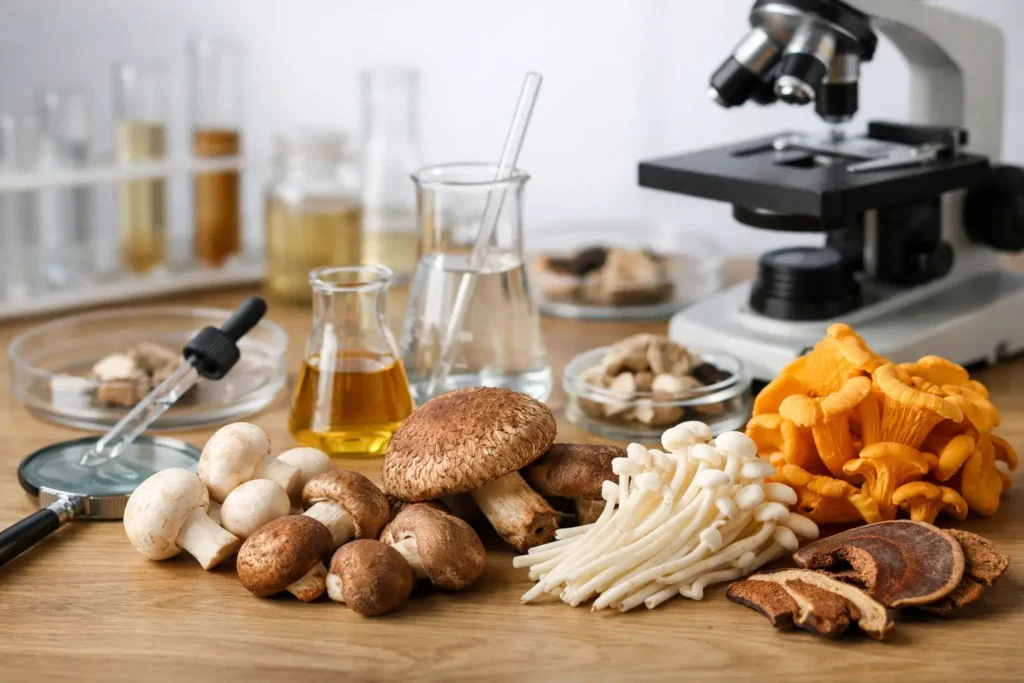
A dried wild mushroom cap and a standardized Lion’s Mane capsule may share the word “mushroom,” but they are not interchangeable products. Their species, source material, processing, intended use, and level of consistency can be entirely different. Good mushroom research starts by recognizing that distinction before comparing prices, formats, or product claims.
For specialty mushroom buyers, the goal is not to find one category that is universally better. It is to identify exactly what a product is, how it was prepared, and whether that format fits the reason you are buying it. Clear categories make better decisions possible.
Start Mushroom Research With the Species Name
Common names are useful, but botanical identity is the first meaningful quality signal. “Amanita,” for example, refers to a large genus with many different species. Amanita muscaria, Amanita pantherina, and Amanita regalis are distinct mushrooms with different natural characteristics. A listing that identifies the species is more informative than one that relies on broad language such as “premium amanita” without further detail.
The same principle applies to functional products. Lion’s Mane generally refers to Hericium erinaceus, while Reishi, Cordyceps, Turkey Tail, and Chaga each refer to different fungi with different traditional histories and constituent profiles. A product should make the mushroom species easy to identify, particularly when a buyer is looking for a specific format or building a regular wellness routine.
Species identification also helps prevent an easy mistake: assuming all mushrooms in a category have the same properties. They do not. Research should be specific enough to answer a simple question: what mushroom am I actually considering?
Wild Material and Functional Formats Serve Different Needs
The most useful distinction in the specialty mushroom market is between raw or minimally processed wild material and functional mushroom products formulated for repeatable use.
Wild-sourced dried caps are botanical material. Their appeal is directness: buyers can examine the natural form, species-specific appearance, and variation that come with a wild mushroom product. Caps can differ in color, shape, size, and density because they are naturally occurring materials rather than standardized manufactured units. For collectors and experienced ethnobotanical customers, that authenticity is often the point.
Functional mushroom capsules and powders are designed differently. They are generally selected for convenience, serving consistency, and integration into a routine. Depending on the product, the material may be fruiting body powder, mycelium-based material, an extract, or a blend. These distinctions matter because they affect how the product is described, portioned, and used.
Neither format should be judged by the standards of the other. Expecting identical visual uniformity from dried wild caps is unrealistic. Expecting a capsule to deliver the same hands-on botanical experience as whole wild material misses its purpose. Mushroom research works best when the product format matches the buyer’s priorities.
Look Beyond the Front Label
A strong product listing does more than present an attractive name. It provides the information needed to assess the material with reasonable confidence. That includes the species, form, net weight or serving information, and whether the product is raw, dried, powdered, extracted, or encapsulated.
For wild mushrooms, product form should be clearly stated. Whole caps, cap fragments, powder, and mixed material are different purchase categories. Whole caps may be preferred by customers who value recognizable morphology, while powder can offer easier measuring but less visual identification. A seller should not blur those differences.
For functional mushroom products, ask what the capsule or powder contains. Is it identified as fruiting body, mycelium, extract, or a combination? Is there a stated serving size? Are other ingredients included? These details are not cosmetic. They determine whether a product fits a buyer’s expectations for simplicity, concentration, and everyday usability.
Claims also deserve scrutiny. Supplements should not be evaluated through dramatic promises or vague language. A more credible presentation focuses on the ingredient, format, sourcing logic, and practical product specifications. Responsible mushroom research means separating what is known about a product from marketing that attempts to imply more than the label can support.
Source and Handling Affect Product Quality
Mushrooms are agricultural or wild-harvested biological materials, so quality begins long before packaging. Wild mushrooms can vary with geography, season, weather, harvest timing, and post-harvest handling. That variation is normal. The relevant question is whether the seller treats it as a reason for better sorting, drying, storage, and honest categorization.
Proper drying is especially important for dried caps and other whole-mushroom formats. Material should be handled and packaged to support stable storage and protect it from excess moisture. Buyers should expect a product that is clearly presented, appropriately packed, and consistent with the stated condition of dried botanical material.
Functional products add another layer: manufacturing control. Powders and capsules should offer clear product information, reliable serving formats, and packaging suited to repeated use. A standardized format is not automatically superior to wild material, but it can be the better choice for someone who values predictability over natural variation.
For customers in the United States and Canada, shipping practices are part of the quality experience as well. Fast order processing, secure checkout, and packaging that protects the product in transit do not replace good sourcing, but they help preserve the quality a buyer expects when placing an online order.
Testing Is Useful, but Context Matters
Lab testing is an important quality tool, especially where identity, purity, and contaminant screening are relevant. Still, “lab tested” is not a complete answer by itself. Meaningful mushroom research asks what was tested, why it was tested, and whether the information relates to the specific product category.
Testing can be relevant to microbial quality, heavy metals, pesticides, or other contaminants, depending on the product and source. For standardized functional products, it may also relate to ingredient verification or measured constituents. The useful takeaway is not that every mushroom product should be identical, but that quality controls should make sense for the material being sold.
Wild-sourced products require a realistic view of natural variation. A foraged cap is not a factory-made ingredient, and its characteristics will not be uniform from piece to piece. Quality in this category is better assessed through accurate species labeling, appropriate condition, careful handling, and transparent presentation than through promises of perfect sameness.
Safety Belongs in Every Purchase Decision
Specialty mushrooms are not casual products simply because they are natural. Buyers should research the species independently, understand the intended product category, and follow all label guidance. People who are pregnant or nursing, have health conditions, take medications, or have known mushroom allergies should speak with a qualified healthcare professional before using mushroom supplements or unfamiliar botanicals.
Wild Amanita products deserve particular care. They should be clearly identified, stored securely, kept away from children and pets, and never confused with culinary mushrooms. Buyers should not rely on internet anecdotes, casual social media advice, or vague product descriptions when assessing a species with distinct ethnobotanical characteristics.
This is where transparent retail categories matter. When raw wild botanicals are kept separate from functional powders and capsules, customers can better understand what they are purchasing and avoid treating fundamentally different products as if they were the same.
A Better Standard for Comparing Mushroom Products
When comparing options, focus on the details that remain useful after the marketing language is removed: the exact species, the product form, source type, processing method, package information, and the seller’s clarity around quality controls. Price can matter, but it should be considered alongside net weight, material type, and the level of consistency you need.
Mario’s Mushrooms is built around that category logic: wild-sourced Amanita caps are presented as specialty botanical products, while functional powders and capsules are positioned for customers who prefer a more repeatable format. That separation helps customers compare products on their actual differences rather than on a single broad label.
The best purchase is usually not the most exotic option or the strongest-sounding claim. It is the product whose species, format, handling, and intended role are clear enough that you know exactly why you chose it.