
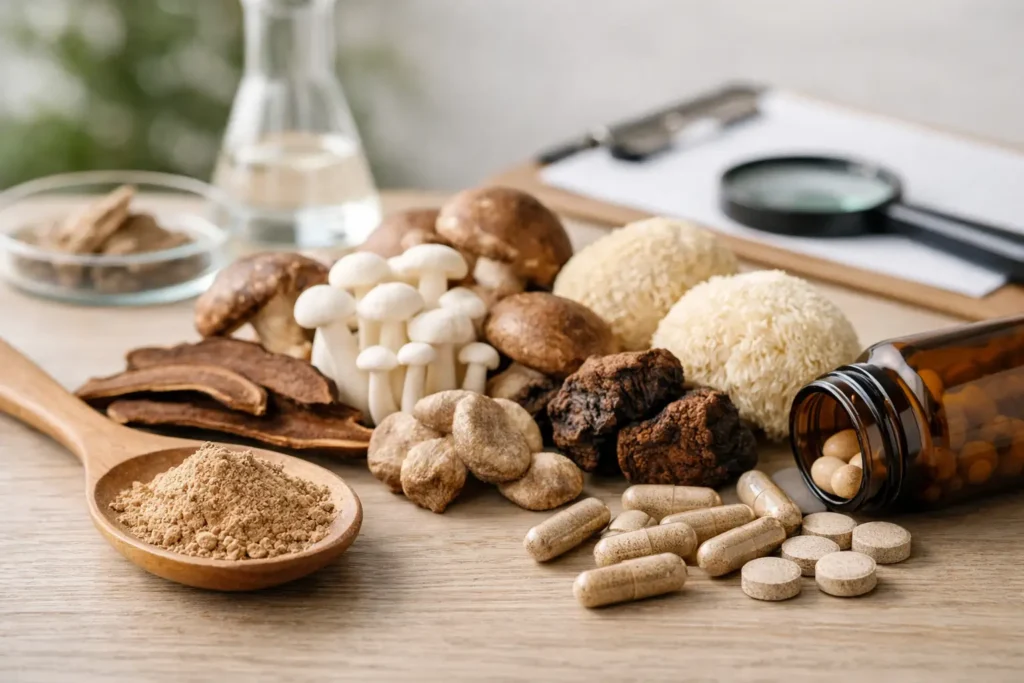
A mushroom label can look premium while revealing very little about what is actually in the container. The practical value of a mushroom supplement sourcing guide is knowing how to separate a clearly identified, well-documented product from one built around vague species claims, generic blends, or attractive packaging.
For experienced mushroom buyers, sourcing is not a background detail. It determines botanical identity, material type, consistency, contamination risk, and whether the format matches the reason you are buying it. A wild-foraged dried cap and a standardized Lion’s Mane capsule may both be mushroom products, but they should not be evaluated by the same criteria.
Start With the Exact Mushroom Species
The first sourcing question is simple: what mushroom is this? A reliable product identifies the species clearly, ideally with its scientific name as well as its common name. “Mushroom complex” or “proprietary fungi blend” may be convenient marketing language, but it gives a buyer limited control over species selection and dose comparison.
This matters because mushroom species differ in their natural compounds, growing conditions, processing needs, and traditional contexts. Lion’s Mane, Reishi, Turkey Tail, Cordyceps, Amanita muscaria, Amanita pantherina, and Amanita regalis are not interchangeable simply because they are all fungi.
A product should also make its category clear. Functional mushroom supplements are generally intended as processed powders, extracts, capsules, or drink mixes designed for repeatable use. Wild Amanita material is a separate botanical category with its own natural variation, sourcing considerations, and safety requirements. Clear category definitions are a positive sign because they prevent buyers from assuming one format behaves like another.
Fruiting Body, Mycelium, and Growing Medium
The phrase “made with mushrooms” does not answer the material question. A supplement may contain fruiting body, mycelium, a combination of both, or mycelium grown on grain and processed with some of that substrate remaining in the finished powder.
Fruiting bodies are the visible mushroom structures most people recognize. They are often favored by buyers seeking a direct connection to the mushroom itself. Mycelium is the thread-like vegetative network of the fungus. It can be a legitimate fungal material, but quality depends heavily on how it was grown, harvested, and separated from its growing medium.
Neither term automatically settles the quality question. A fruiting-body powder should still identify the species and processing method. A mycelium product should explain whether it is a pure biomass, a cultured preparation, or a grain-based material. What buyers should avoid is ambiguity. If the label does not tell you which material was used, you cannot make a meaningful comparison.
For capsules and powders, look beyond the front-label image. The Supplement Facts panel, ingredient statement, and product description should align. If the front says Lion’s Mane but the ingredient panel centers on rice, oats, or an unspecified mushroom biomass, that distinction deserves attention.
Extraction Method Should Match the Product
Extraction is not a universal upgrade. It is a processing decision that should fit the mushroom and the intended format.
Whole mushroom powders retain the full ground material. They can be appropriate for buyers who want a minimally processed format and understand that natural composition can vary from batch to batch. Extracts use solvents such as hot water, alcohol, or both to concentrate selected constituents. These are commonly dried into powders for capsules, tinctures, and blends.
Hot-water extraction is often used for compounds that dissolve in water, while dual extraction combines water and alcohol steps to capture a broader range of soluble constituents. That does not mean every product needs dual extraction. It means the manufacturer should be able to state what was done and why.
Be cautious with broad phrases such as “maximum potency” when no extraction ratio, solvent method, or standardized marker is disclosed. An extract ratio can provide context, but it is not a standalone quality score. A 10:1 ratio means little without knowing the starting material, extraction process, and final test results.
What Testing Can Actually Tell You
Testing is where sourcing moves from a story to a verifiable process. For functional products, a serious quality program commonly considers identity, heavy metals, microbial contamination, and other relevant contaminants. Depending on the product and sourcing region, pesticide screening and residual solvent testing may also be appropriate.
Identity testing helps confirm that the material is the stated species. This is especially valuable with powders, where visual inspection cannot reliably establish botanical identity. Heavy-metal and microbial testing matter because mushrooms can interact closely with their growing environment, and dried material can be affected by handling and storage conditions.
For extracts, some brands also report standardized compounds or beta-glucan content. These figures can be useful, but they need context. Beta-glucans occur in fungal cell walls, yet a high number alone does not establish that a product is right for every purpose. It should be considered alongside species, mushroom material, extraction method, serving size, and independent testing practices.
A company does not need to publish every internal document on a product page. It should, however, communicate its quality controls clearly and answer reasonable questions about lot testing, material origin, and specifications. “Lab tested” without further detail is a starting point, not a complete sourcing standard.
Wild-Sourced Material Requires Different Questions
Wild mushrooms offer something cultivated supplements cannot fully replicate: natural origin, seasonal character, and material shaped by its native environment. That authenticity is meaningful to ethnobotanical collectors and specialty mushroom buyers. It also introduces variation in size, appearance, moisture, and composition.
When assessing wild-sourced dried caps, ask whether the species is identified precisely, whether collection and drying standards are controlled, and whether the seller distinguishes raw botanical material from functional supplement products. A reliable retailer does not blur those categories or imply that all mushroom formats serve the same purpose.
Amanita products require particular care. Species-level identification is essential, and dried Amanita caps are not conventional dietary supplements. Buyers should research applicable laws, understand the distinct nature of the material, and follow all product-specific safety information. Never treat an unfamiliar wild mushroom product as equivalent to a daily wellness capsule.
Visual variation is not automatically a defect in wild material. Cap size, color, and surface texture naturally differ. The more relevant questions are accurate identification, clean handling, controlled drying, proper packaging, and transparent presentation of what the customer will receive.
Read Labels for Useful Details, Not Just Claims
The strongest labels make comparison easier. They identify the mushroom, state the form, provide the amount per serving, and list all other ingredients. They also avoid making the buyer guess whether the product is a powder, extract, blend, or raw dried material.
Four label details are especially useful when comparing functional mushroom products:
- The exact species, ideally including the Latin name.
- The mushroom material used, such as fruiting body or mycelium.
- The processing format, including powder, water extract, dual extract, or tincture.
- The amount of mushroom material per serving and any declared standardized compounds.
Ingredient simplicity can be an advantage, although it depends on the format. Capsules require a capsule shell, and drink blends may include flavoring or a carrier. The goal is not necessarily a one-ingredient product. The goal is a formula that is fully disclosed and easy to understand.
Evaluate Consistency Against Your Buying Goal
The right sourcing standard depends on what you want from the product. If your priority is a repeatable daily functional routine, a clearly standardized capsule or extract with consistent serving information may be the better fit. If your interest is wild botanical authenticity, natural variation may be part of the appeal, provided the product is accurately identified and responsibly handled.
Price should be interpreted through the same lens. A low-cost powder may be economical because it uses a simpler processing method, a smaller amount of mushroom material, or a grain-based mycelium format. A higher-priced extract may reflect testing, concentrated processing, or more demanding raw-material specifications. Neither price point proves quality on its own.
For buyers in the United States and Canada, practical reliability matters too. Clear inventory status, secure checkout, careful packaging, and fast order processing are not separate from sourcing. A product can be well made at origin and still arrive compromised if fulfillment standards are weak.
Build a Better Mushroom Supplement Buying Habit
A strong mushroom supplement sourcing guide is less about finding a perfect buzzword and more about building a repeatable evaluation process. Confirm the species. Identify the material. Understand the processing. Look for credible testing and clear labeling. Then decide whether the product’s level of standardization suits your expectations.
At Mario’s Mushrooms, the distinction between raw, wild-sourced botanical material and processed functional mushroom formats is kept clear for a reason: informed buyers should know exactly which category they are choosing. The best product is the one with a transparent origin, a format that fits your use case, and details substantial enough to support a confident purchase.