
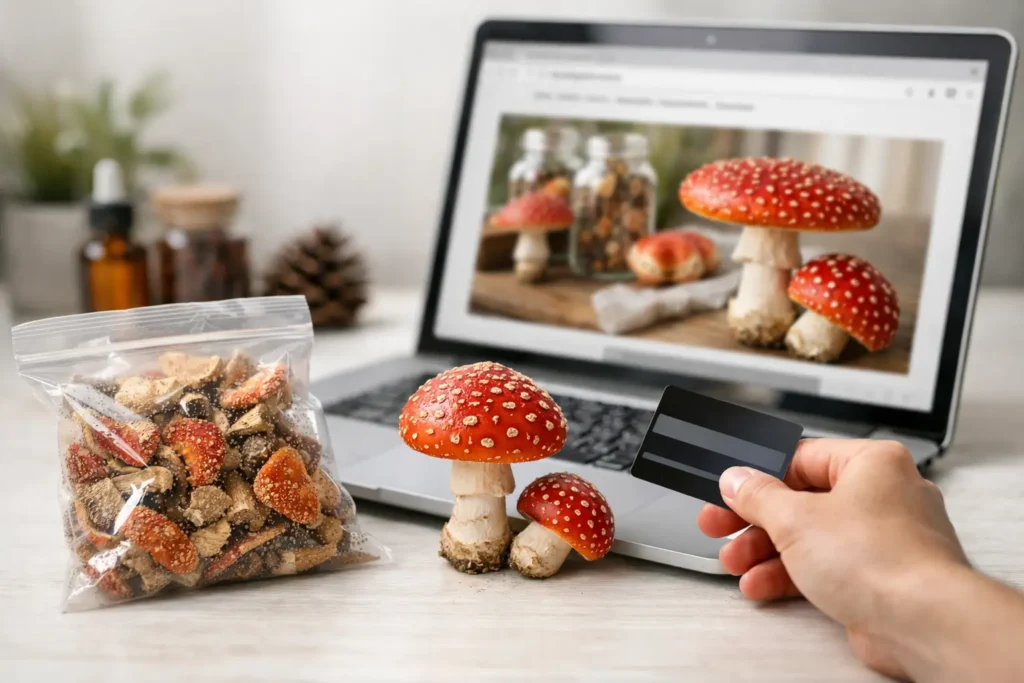
A listing with a bright red cap photo is not enough information to make a sound purchase. Knowing how to buy amanita online starts with identifying the exact species, understanding the format being sold, and choosing a retailer that treats an unusual botanical product with appropriate clarity. Amanita products are not interchangeable with everyday mushroom supplements, and a serious seller should never present them that way.
For adult buyers in the U.S. and Canada, the best online purchase is rarely the cheapest option or the listing with the boldest claims. It is the product that is clearly categorized, accurately labeled, responsibly packaged, and sold with transparent ordering policies.
Start With the Exact Amanita Species
“Amanita” describes a large genus, not a single mushroom. An online store should state the full species name prominently rather than relying on a general category label or a product nickname. Amanita muscaria, Amanita pantherina, and Amanita regalis are distinct wild mushrooms with different appearances, sourcing considerations, and botanical profiles.
This detail matters because visual similarity does not establish species identity. A red-orange cap may be associated with Amanita muscaria, while darker caps may appear in other Amanita varieties, but color alone can vary with age, weather, handling, and photography. Purchase from a retailer that identifies products by species and does not ask customers to infer what they are buying from a photograph.
Avoid listings that use vague terms such as “magic mushroom,” “premium forest caps,” or “mushroom blend” without a clear botanical name. Those descriptions create uncertainty at the exact point where buyers need precision. A specialty retailer should make it easy to distinguish one Amanita species from another before an item reaches the cart.
Understand What Product Format You Are Ordering
The product format tells you a great deal about what you can reasonably expect from an order. Dried Amanita caps are raw, wild-sourced botanical material. Their shape, cap size, color, and natural variation are part of the product. They are not standardized supplements, and they should not be marketed as though every piece will look or behave identically.
Functional mushroom powders and capsules belong in a separate category. Products featuring mushrooms such as Lion’s Mane are often designed for regular wellness routines and may be processed into a more consistent powder, capsule, or extract format. That does not make one category better than the other. It means the buyer should select the category that matches the intended product experience.
A well-organized catalog makes this distinction obvious. Raw wild mushrooms should be described as raw botanical products, while functional formats should clearly state whether they contain fruiting body material, mycelium, extract, powder, or a combination. If a retailer blends these categories together or implies that all mushroom products serve the same purpose, look elsewhere.
Read Product Details Beyond the Main Image
Before ordering, review the information that sits below the product title. At minimum, a useful listing should tell you the species, product form, quantity or weight, and whether the material is whole caps, pieces, powder, or another format. It should also explain any natural variation buyers may see.
For wild-harvested material, variation is normal. A larger cap is not automatically superior to a smaller one, and an intense color is not a universal quality marker. What matters more is that the retailer represents the material honestly, stores it appropriately, and describes the format without inflated promises.
Be cautious with claims that sound more precise than the product can support. Wild botanicals naturally vary from harvest to harvest. No product page should imply pharmaceutical uniformity for unmodified dried caps. Clear expectations are a stronger quality signal than exaggerated certainty.
Check Sourcing, Handling, and Quality Signals
When buying a specialty mushroom online, quality is not one single credential. It is a chain of decisions that begins with sourcing and continues through sorting, drying, storage, packing, and fulfillment. Reliable stores communicate enough about that process to show that the product is handled as a serious botanical item rather than an anonymous novelty.
Look for species-specific labeling, clean product photography, straightforward weights, and packaging information that protects dried material from unnecessary moisture and damage. Secure checkout, clear shipping timelines, and accessible customer-service policies also matter. They indicate whether a retailer has built an actual ecommerce operation instead of simply posting inventory online.
Testing and documentation can be useful, but read those materials carefully. A report should identify what was tested, when it was tested, and which product or batch it applies to. A generic certificate without a matching product reference offers limited value. Likewise, testing does not replace accurate species identification, responsible handling, or compliance with local regulations.
Mario’s Mushrooms approaches this category through clear product separation: wild Amanita caps are presented as specialty botanical products, while functional mushroom powders and capsules are organized for buyers seeking more repeatable formats. That distinction helps customers compare products on honest terms.
Confirm Legal and Shipping Eligibility Before Checkout
Availability online does not automatically mean a product may be shipped to every address. Laws, import rules, age requirements, and carrier restrictions can differ by country, state, province, territory, or municipality. They can also change over time.
Check the retailer’s shipping policy and review the rules that apply where you live before placing an order. A responsible seller may limit destinations, decline orders that conflict with its policies, or require buyers to confirm they are adults. These controls are not an inconvenience. They are part of operating responsibly in a category where regulations can be specific and uneven.
For cross-border purchases between Canada and the U.S., pay particular attention to customs and import considerations. A seller’s willingness to accept an order does not guarantee that a shipment will clear every border requirement. If the legal status is unclear in your area, do not rely on forum posts, social media comments, or old product reviews as legal guidance.
Evaluate the Retailer, Not Just the Product
A strong product page matters, but the rest of the store should support it. Review the checkout process, payment security indicators, shipping terms, privacy policy, and return or damaged-order policy. Specialty products need careful packaging and accurate order fulfillment, especially when dried caps can be fragile in transit.
It is also worth checking whether the seller’s catalog has a logical structure. A store that clearly differentiates Amanita species, wild-sourced caps, functional powders, and capsules is making it easier for customers to buy intentionally. Clear category architecture is not just a design choice. It reflects whether the retailer understands the products it sells.
Be skeptical of stores that rely on urgency tactics, unrealistic discounts, medical claims, or unclear contact information. Premium positioning should be supported by visible operational standards, not by dramatic language. Fast processing, secure payment, accurate order confirmation, and transparent product descriptions are more meaningful than hype.
Common Buying Mistakes to Avoid
The most common mistake is purchasing based on a product photo alone. The second is assuming every mushroom listing is a wellness supplement. Amanita products and functional mushroom products should be evaluated through different expectations, formats, and product descriptions.
Another mistake is treating online commentary as a substitute for product information. Individual experiences are not quality documentation, and they do not verify species, freshness, sourcing, or legal eligibility. Use the retailer’s current listing details and policies as the starting point, then make a decision based on information that applies to the exact item in your cart.
Finally, do not buy more than you can reasonably inspect and store correctly. For a first order, a smaller quantity from a transparent retailer can be a better way to assess packaging, product condition, and fulfillment reliability than placing a large order from an unknown source.
A Better Standard for Buying Amanita Online
The right purchase begins with specificity: a named species, an accurately described format, clear quality signals, lawful shipping, and a retailer that communicates without ambiguity. Buyers interested in natural, wild-sourced Amanita material should expect variation and transparency. Buyers seeking routine-oriented mushroom formats should look for products designed and labeled for that purpose.
Amanita is a category where careful buying is part of product quality. Choose the seller that makes it easy to understand exactly what is being offered before you commit to an order.