
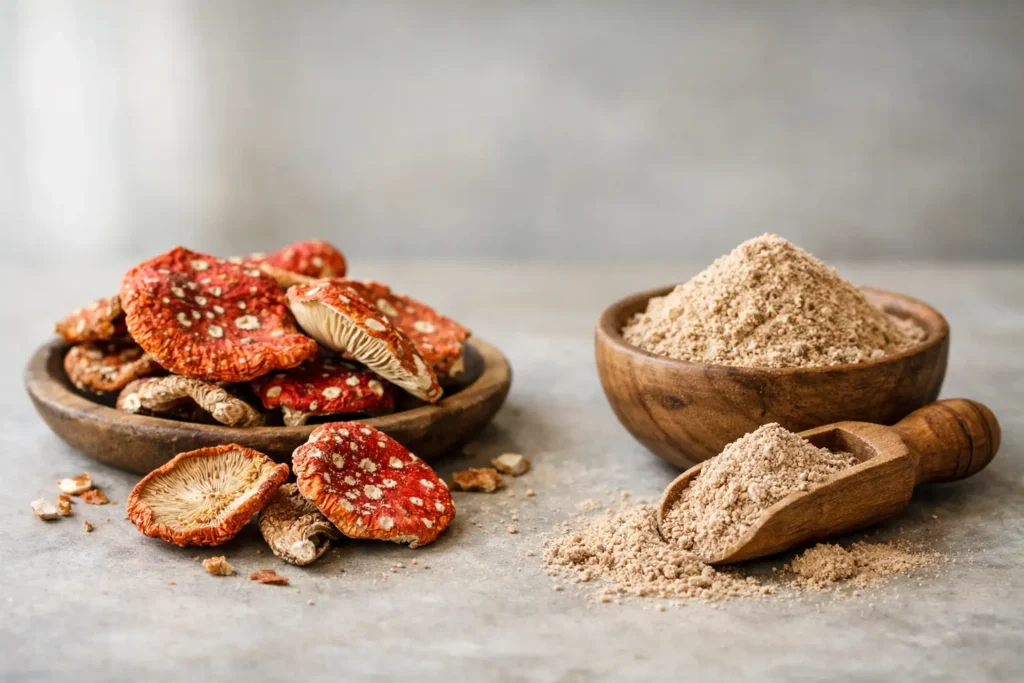
A whole cap and a powder can come from the same mushroom species, yet they are not automatically the same product category. When comparing dried amanita caps versus powders, the meaningful differences are not just visual. Source material, processing, batch variation, labeling, and the reason you are buying all matter.
For specialty mushroom buyers, the first question is not which format is better. It is whether the item is raw wild botanical material, ground whole-mushroom material, or a processed functional mushroom product. Clear category separation prevents false equivalencies and helps you purchase with appropriate expectations.
Dried Amanita Caps Preserve the Original Material
Dried Amanita caps are whole or largely intact fruiting bodies that have been dehydrated for preservation. Their appeal is straightforward: they retain the recognizable structure, color, and character of the mushroom. For collectors and ethnobotanical customers, that visible authenticity is often part of the value.
A premium dried cap product should identify the species clearly. Amanita muscaria, Amanita pantherina, and Amanita regalis are distinct wild mushrooms, not interchangeable names for a generic Amanita product. Their appearance, provenance, and natural chemical profiles can differ. A responsible product category keeps those distinctions visible rather than blending them into a vague “mushroom powder” label.
Whole caps also give buyers a direct view of condition. You can assess whether material is cap-forward, how intact it is, and whether the product reflects careful sorting and drying. Natural variation is expected with wild-sourced mushrooms. Cap size, color, texture, and visual markings can vary by season, region, and individual specimen.
That variation is a feature for buyers seeking unmodified material, but it is not the same as uniformity. Dried caps are a raw botanical format, not a standardized supplement. They should be purchased and handled with that distinction in mind.
Powders Can Mean Several Very Different Things
“Powder” is one of the least precise words in mushroom retail. It can describe ground dried caps, milled fruiting bodies, mycelium-based material, extract powders, or a functional blend containing several ingredients. The word alone does not tell you what is inside.
A powder made by milling dried Amanita caps remains close to the original raw material, but its physical form has changed. Grinding creates a more uniform-looking product and removes the visual cues available in whole caps. Unless a seller states the species, plant part or mushroom part, and processing method, it can be difficult to determine what the powder represents.
Functional mushroom powders occupy a different category. These are commonly formulated around species such as Lion’s Mane and may use fruiting body powders, extracts, or other standardized ingredients. They are designed for easier incorporation into established wellness routines, where consistency, clear serving information, and repeatability are usually primary considerations.
The key point is simple: an Amanita powder is not automatically comparable to a Lion’s Mane powder, and a ground wild mushroom is not automatically comparable to an extract-based functional formula. Buyers should compare like with like.
Dried Amanita Caps Versus Powders: The Practical Differences
The choice often comes down to authenticity, convenience, and the level of consistency you expect from the category.
Dried caps provide maximum visual transparency. You are purchasing identifiable mushroom material in a minimally altered form. This is especially relevant for experienced collectors, botanical enthusiasts, and customers who value species-specific wild sourcing. The trade-off is that a whole-material product naturally carries more variation from one specimen or batch to another.
Powders prioritize handling convenience. They are compact, easy to portion for non-consumptive uses such as specimen organization or ingredient review, and simpler to store without handling individual caps. However, a powder conceals the original form. That makes trustworthy labeling, lot control, and clear source disclosure more important, not less.
Processed functional powders prioritize routine usability. When a customer wants a product that fits a repeatable supplement format, a clearly labeled functional mushroom powder or capsule is generally easier to compare across purchases. These products should state what type of material they contain and avoid implying that raw wild Amanita material has the same standardized profile.
Neither format is universally superior. Whole dried caps are often the better fit when botanical identity and unmodified presentation are central. Powders make more sense when format convenience is the priority, provided the seller is specific about exactly what has been milled or formulated.
What Product Labels Should Tell You
A clear label reduces uncertainty before an order is placed. For dried Amanita products, look first for the full species name. “Amanita” by itself is too broad to communicate meaningful botanical identity.
The listing should also distinguish between whole caps, cap fragments, ground material, and blended products. These are different formats with different levels of visible traceability. If a powder is sold as a whole-mushroom powder, that should be stated plainly. If it is an extract or a blend, the product should identify that processing category rather than relying on broad wellness language.
Origin and handling details add useful context for wild material. Wild-foraged mushrooms are inherently seasonal and variable, so transparent sourcing and careful product categorization are more valuable than claims of identical appearance from batch to batch. For functional products, consistency depends more heavily on the stated ingredient format and manufacturing controls.
It is also reasonable to consider packaging and order handling. Dried mushrooms are sensitive to moisture and rough handling. Secure packaging, fast processing, and organized product pages support product condition and make it easier to verify that you are ordering the intended format.
Avoid Treating Amanita as a Standard Wellness Powder
This distinction deserves direct attention. Amanita muscaria, Amanita pantherina, and Amanita regalis are not conventional culinary mushrooms or interchangeable daily wellness supplements. They can contain naturally variable bioactive compounds, and species-level identification matters.
Do not assume that a wild Amanita product is appropriate for routine use because it appears beside functional mushroom powders in a retailer’s catalog. A well-organized catalog separates raw ethnobotanical products from processed functional products precisely because the formats, expectations, and safety considerations differ.
Buyers should also avoid relying on casual online claims, visual identification alone, or generalized mushroom advice. If you are considering any personal use of a specialty botanical product, seek qualified medical guidance and review applicable local rules. Keep products securely stored and away from children and pets.
Choosing the Format That Matches Your Goal
Choose dried caps when you value intact, recognizable wild mushroom material and want the product format to show its natural character. This is the format for buyers who place botanical specificity, physical inspection, and minimal alteration at the center of the purchase.
Choose a ground Amanita product only when the listing clearly identifies the exact species and confirms that the material is genuinely milled whole mushroom rather than an unclear blend. Powder is convenient, but convenience should never replace transparency.
Choose functional mushroom powders or capsules when your priority is a clearly defined, repeat-purchase wellness format. These products are best evaluated by ingredient disclosure, mushroom material type, and consistency of formulation, not by comparisons to wild dried caps.
Mario’s Mushrooms keeps these categories distinct so customers can shop for wild specialty material and functional mushroom formats without confusing one for the other. That clarity is more useful than forcing every mushroom product into a single “powder versus whole” decision.
The strongest purchase is the one whose format, species, and labeling all match your purpose. Start with what the product actually is, not what its packaging seems to imply.