
Amanita is not one uniform mushroom product, and that distinction matters before you compare caps, species, or product formats. The top questions about Amanita usually come down to the same practical concerns: what it is, how different species compare, what quality looks like, and where the boundaries are between wild botanical material and everyday functional mushroom supplements.
For experienced mushroom buyers, clear category information is more useful than vague promises. Amanita products deserve careful labeling, species-level identification, and realistic expectations about natural variation.
Top Questions About Amanita: The Basics
What is Amanita?
Amanita is a large genus of mushrooms that includes many very different species. Some Amanita species are highly toxic, while others are known in ethnobotanical contexts or sold as clearly identified dried mushroom material. That range is exactly why the genus should never be treated as a single interchangeable category.
Products commonly discussed in specialty mushroom retail include Amanita muscaria, Amanita pantherina, and Amanita regalis. These are wild mushroom species with distinct appearances, chemical profiles, and handling considerations. A listing that simply says “Amanita” without identifying the species leaves out information a knowledgeable buyer needs.
Species identification is not a cosmetic detail. It is the foundation for accurate product categorization, responsible sourcing, and informed decisions.
Are all Amanita mushrooms the same?
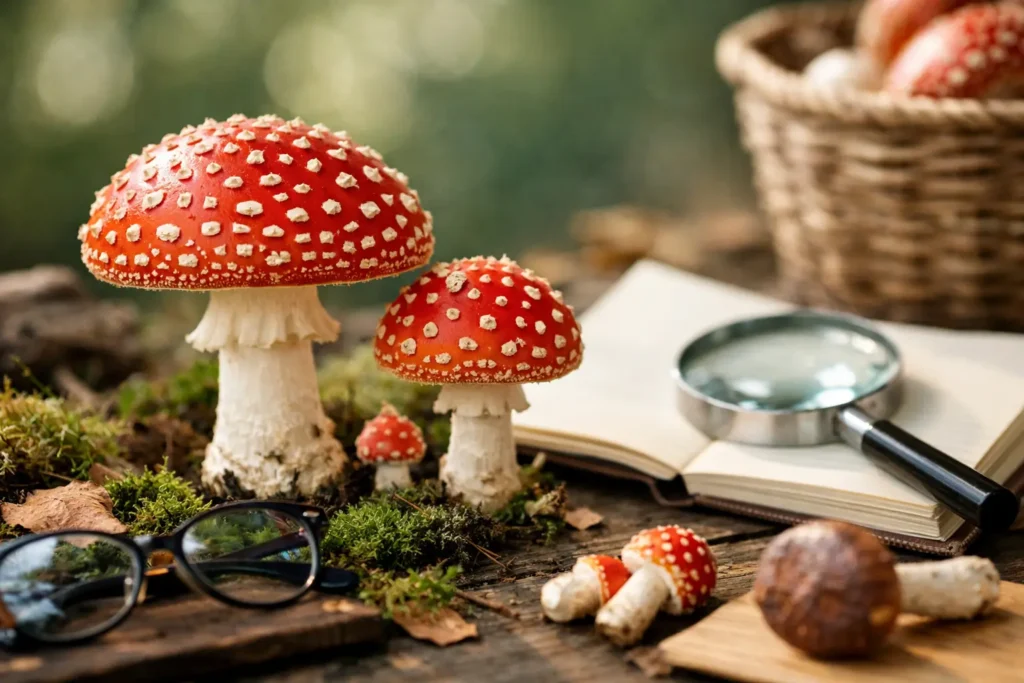
No. The visible resemblance between some Amanita mushrooms can be misleading, and different species may vary substantially in potency, constituent balance, appearance, and risk profile. Amanita muscaria is often recognized by its red or orange cap and pale spots, although color can vary by region and maturity. Amanita pantherina is typically darker and is often regarded as a materially different species rather than a stronger version of A. muscaria. Amanita regalis also has its own identifying characteristics and should be sold under its proper botanical name.
There is no responsible shortcut that treats these species as equivalent. Buyers should expect the product name, species, form, and origin information to match what is actually being offered.
Why do Amanita caps vary so much in color and shape?
Wild mushrooms are biological material, not factory-made units. Weather, soil conditions, forest ecology, maturity at harvest, drying methods, and seasonal conditions all affect cap size, color, spotting, and texture. A dried cap may look very different from the iconic illustrations many people associate with Amanita.
Variation does not automatically signal poor quality. What matters is whether the material has been accurately identified, handled carefully, dried appropriately, and presented honestly. Uniformity can be useful in standardized supplements, but wild-sourced caps should retain some natural differences from piece to piece.
Wild Amanita Caps vs. Functional Mushroom Products
Is Amanita a functional mushroom supplement?
Not in the same sense as a standardized Lion’s Mane, Reishi, or Cordyceps powder or capsule. Functional mushroom products are generally positioned for repeatable wellness routines and may be processed, extracted, blended, or standardized to support consistency from serving to serving.
Wild Amanita caps are a separate category. They are raw botanical material, often wild-sourced and dried, with natural variation that cannot be reduced to a simple supplement-style promise. Treating them like an ordinary daily wellness capsule creates confusion about both product purpose and expected consistency.
This is one of the most useful distinctions for shoppers. If your priority is a measured, routine-friendly format, a clearly labeled functional mushroom powder or capsule may be the better category. If your interest is in a specific wild Amanita species as natural dried material, look for transparent species identification and a seller that keeps this category separate from conventional supplements.
Why does standardized material cost differently from wild caps?
The two formats involve different inputs and quality controls. Wild caps depend on seasonal availability, careful species sorting, drying, storage, and the realities of foraged material. Standardized functional products may involve extraction, testing, formulation, encapsulation, and batch consistency work.
Neither format is automatically superior. The right choice depends on whether you value wild authenticity and species-specific material or predictable format and repeatable use. Price comparisons make sense only when you compare like with like.
Safety Questions Buyers Should Ask First
Are Amanita mushrooms safe?
Safety depends on the exact species, the product’s identification, the buyer’s health context, and how the material is handled. The Amanita genus includes dangerously poisonous mushrooms, and wild mushroom misidentification can have severe consequences. Never consume a mushroom that was personally foraged or obtained from an unknown source based on photos, informal advice, or a presumed resemblance to a known species.
Even correctly identified Amanita products are not appropriate for everyone. People who are pregnant or nursing, managing a medical condition, taking prescription medications, or affected by mental health or substance-use concerns should speak with a qualified healthcare professional before considering any unfamiliar botanical product. Amanita should also be kept securely away from children and pets.
Avoid combining Amanita products with alcohol, sedatives, sleep medications, or other substances that affect the central nervous system. If someone experiences concerning symptoms after exposure to a mushroom product, contact emergency services or a poison control center immediately. Product packaging should be retained for identification.
Can a seller guarantee a particular experience or effect?
No responsible seller should make that claim. Natural Amanita material can vary across species, harvests, regions, and individual caps. Personal response can vary as well. Product descriptions should focus on what can be verified: species, form, sourcing approach, condition, and storage guidance.
Be cautious with listings that promise a fixed outcome, present Amanita as a treatment for a medical condition, or blur the line between wild botanical material and a regulated medicine. Clear, limited claims are a quality signal because they respect what the product can and cannot reliably deliver.
Is Amanita legal in the United States and Canada?
Rules can vary by country, state, province, city, and intended use. A product being offered online does not remove a buyer’s responsibility to understand local regulations. Laws also change, particularly around products associated with novel psychoactive or ethnobotanical categories.
Before ordering, review the rules that apply where you live and confirm that the seller’s shipping policies align with those requirements. Buyers should also avoid assuming that one Amanita species is regulated exactly like another.
What Quality Looks Like in Dried Amanita
What should I look for on a product page?
A quality listing should identify the species in plain language and, ideally, with its botanical name. It should state whether the product is whole caps, cap pieces, powder, or another form. This matters because whole caps allow buyers to inspect the natural material, while pieces and powders are less visually identifiable and require even more confidence in the supplier’s sorting and labeling practices.
Look for a clear separation between Amanita products and functional mushroom supplements. Product pages should not use supplement-style language to imply that raw wild caps offer standardized consistency. Transparent descriptions may also explain that appearance varies naturally by harvest.
Operational details matter, too. Accurate inventory, secure checkout, responsive processing, protected packaging, and sensible storage instructions all support a better specialty mushroom purchase. Premium positioning should be backed by information and handling standards, not just elaborate product names.
Is lab testing relevant?
Testing can be valuable, especially when it addresses identity, contaminants, or other relevant quality markers. But a lab report is only useful when the buyer understands what it measures and what it does not. A test for one marker does not erase natural biological variation, establish universal suitability, or turn a wild mushroom into a standardized supplement.
The strongest quality approach combines multiple controls: correct species identification, responsible sourcing, clean drying and storage practices, honest category labeling, and testing where appropriate. No single badge replaces that full chain of care.
How should dried Amanita be stored?
Dried caps should be kept sealed in a cool, dry, dark location, away from heat, humidity, and direct sunlight. Moisture is the primary concern because it can compromise texture and condition. Use the original sealed packaging when practical, and do not leave material exposed in a kitchen, vehicle, or other area with changing temperatures.
Keep the product clearly labeled and separated from food items, especially in shared households. If the material develops unusual moisture, visible mold, a strongly off odor, or signs of contamination, do not use it.
A Better Standard for Buying Specialty Mushrooms
The most valuable questions are not only about a mushroom’s name. Ask whether the species is clearly identified, whether the format matches your purpose, whether natural variation is explained honestly, and whether the seller distinguishes wild botanicals from standardized functional products.
That level of clarity protects the buyer and raises the standard for the category. Amanita is best approached with curiosity, precision, and respect for the difference between a remarkable wild mushroom and a routine supplement format.