
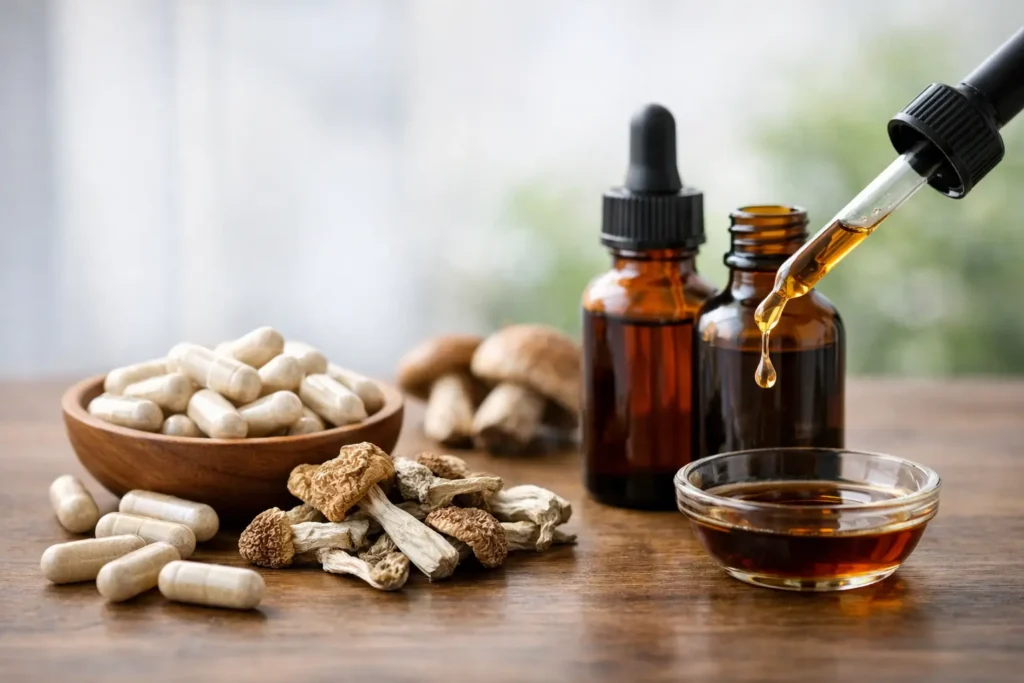
A whole cap tells you what it is at a glance: species, fruiting-body form, natural color variation, and the fact that it has not been converted into an extract. That directness is the central distinction in dried caps vs tinctures. One format preserves recognizable mushroom material; the other is a prepared liquid whose value depends heavily on extraction method, ingredient disclosure, and batch consistency.
For buyers interested in specialty mushrooms, choosing between them is not simply a matter of convenience. It is a decision about raw botanical authenticity versus a more measured, portable format. The right choice depends on the species, your intended use, and how much transparency the product label provides.
Dried caps are whole, minimally processed material
Dried caps are mushroom fruiting bodies that have been dehydrated for stability and storage. In the specialty mushroom category, this format is especially relevant to wild-sourced Amanita varieties such as Amanita muscaria, Amanita pantherina, and Amanita regalis. Their individual appearance is part of the product: cap shape, surface texture, color, and natural variation can differ between harvests.
That variation is not automatically a quality problem. Wild mushrooms are agricultural and seasonal materials, not manufactured tablets. A premium dried-cap product should be accurately identified, cleanly handled, thoroughly dried, and categorized by species and format. It should not be presented as interchangeable with a standardized supplement.
The advantage is material integrity. Buyers can assess the physical botanical product and know they are purchasing a dried fruiting body rather than a blend, concentrate, or liquid formula. This is often the preferred format for collectors, experienced ethnobotanical customers, and anyone who specifically values unmodified mushroom material.
The trade-off is that dried caps are inherently less uniform from piece to piece. Size and appearance can vary, and responsible product descriptions should make clear whether the item is wild-sourced raw material or a processed functional mushroom product. Storage also matters: dried mushrooms should remain sealed, dry, and protected from unnecessary heat, moisture, and direct light.
Tinctures are extracts, not a universal product type
A tincture is a liquid preparation made by extracting botanical compounds into a solvent, commonly alcohol, glycerin, water, or a combination of these. The word sounds precise, but it does not by itself tell you what mushroom material was used, what compounds were extracted, or how concentrated the final liquid is.
This is where buyers need to read beyond the front label. Two bottles described as mushroom tinctures can be fundamentally different products. One may be made from fruiting bodies, another from mycelium, and another from a blended extract. The liquid may contain alcohol, vegetable glycerin, water, flavoring ingredients, or other botanicals. Unless the label identifies the species, source material, solvent system, extract ratio or standardization approach, and serving information, meaningful comparison is difficult.
For functional mushroom products, tinctures can offer a repeatable format that fits a daily routine. A clearly labeled Lion’s Mane extract, for example, belongs in a different category from a package of wild Amanita caps. Neither is inherently superior. They answer different buyer priorities: routine-friendly consistency on one side, raw and recognizable material on the other.
A liquid format also has practical limitations. Tinctures are bulkier to ship than dried material, can be sensitive to heat and light, and may not suit people who avoid alcohol or certain added ingredients. Their shelf stability depends on the formulation, packaging, and storage guidance, not simply on the word tincture.
Dried caps vs tinctures: the comparison that matters
The most useful comparison is not “natural versus processed.” Both formats can be derived from natural mushrooms. The real question is how much the product has been transformed and how clearly that transformation is documented.
Dried caps offer high traceability at the material level. You can see the fruiting body, identify the listed species, and understand the basic processing step: dehydration. They are best evaluated through correct species identification, condition, sourcing standards, and drying quality.
Tinctures offer a more controlled delivery format only when the manufacturer controls and discloses the process. A dependable tincture should identify whether it uses fruiting bodies or mycelium, state the extraction medium, list all ingredients, and provide usable information about concentration or standardization. Without those details, a tincture may be convenient but not especially comparable from one brand to another.
This distinction is particularly important with Amanita products. A dried Amanita cap is raw botanical material with natural variability. It should not be assumed to have the same composition, effects, or handling profile as a liquid mushroom extract. Likewise, a generic “mushroom tincture” label should never be treated as proof that it contains the same species or characteristics as a specialty dried cap.
Consistency means different things in each format
Consistency is often used as a shortcut for quality, but it needs context. With dried caps, consistency means accurate species sorting, careful handling, reliable dryness, and a product that arrives in sound condition. It does not mean every cap will look identical.
With tinctures, consistency can mean repeatable formulation from bottle to bottle. That is valuable for customers who prefer a familiar product format, particularly within functional mushroom routines. Yet consistency claims should be supported by transparent specifications rather than broad marketing language. A label that says “premium extract” without explaining the extract is not giving buyers enough information.
For many shoppers, the clearest solution is to keep categories separate. Choose whole dried caps when the objective is authentic, visible mushroom material. Choose a standardized functional format when the objective is predictable routine use and convenient packaging. Trying to judge both products by the same criteria creates confusion.
What to check before purchasing either format
Start with species identification. The full mushroom name should be clear, especially for specialty Amanita products where species are not interchangeable. Next, confirm the product category: whole dried fruiting bodies, powder, capsule, extract, or tincture. Those terms describe materially different products.
For dried caps, look for straightforward statements about source, format, and condition. For tinctures, prioritize full ingredient lists and extraction details. If a product is marketed for functional wellness, it should be clearly separated from raw wild mushroom material rather than implying they are equivalent.
Packaging and fulfillment matter as well. Dried material benefits from protective, moisture-conscious packaging. Liquids need secure seals and careful handling in transit. For buyers in the United States and Canada, clear availability information, secure checkout, and prompt order processing are practical signs that a specialty retailer understands the product category it serves.
Avoid assuming one format replaces the other
A common purchasing mistake is treating a tincture as an upgraded version of dried caps, or treating dried caps as a more “pure” version of every mushroom product. Those assumptions skip the essential question: what do you actually want to buy?
If you want a wild-sourced, minimally altered mushroom specimen, dried caps are the direct format. If you want a processed mushroom product designed around measured labeling and repeatable use, a properly documented tincture may be a better fit. For functional mushrooms, powders and capsules can also be worth considering when you want ingredient transparency without the storage considerations of liquid extracts.
With Amanita and other specialty wild mushrooms, responsible purchasing also means respecting species-specific risks, local rules, and product labeling. Do not rely on broad online claims or assume that a familiar supplement format makes every mushroom appropriate for the same purpose. When there is uncertainty, choose clearer product information rather than stronger marketing.
The strongest purchase decision is usually the simplest one: buy dried caps for the visible, wild botanical material they are, and buy tinctures only when the label makes the extract itself easy to understand. That clarity leaves less room for guesswork and more room for choosing a mushroom product that genuinely matches your standards.