
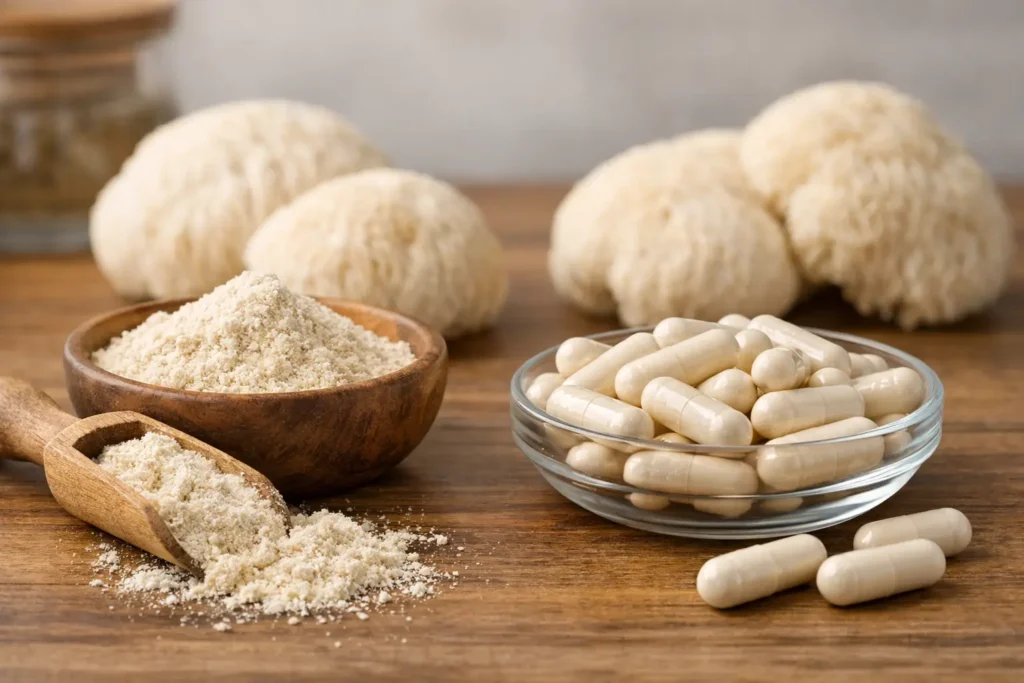
A jar of Lion’s Mane powder can look nearly identical to a jar of capsules from the outside. The meaningful differences are inside: the mushroom material used, whether it has been extracted, how much you will actually take, and whether the format fits your routine well enough to use consistently. The best lion’s mane supplement form is not automatically the most expensive or the most convenient. It is the format with clear sourcing, appropriate processing, and a serving style you will realistically maintain.
For buyers who already understand the difference between whole mushroom material and processed functional products, Lion’s Mane is a category where label details deserve close attention. A powder, capsule, tincture, or gummy can each have a place, but they are not interchangeable.
Best Lion’s Mane Supplement Form for Your Routine
For most people, the decision comes down to powder versus capsules. Powder offers flexibility and a more direct, food-like format. Capsules offer measured servings, portability, and less sensory friction. Extracts can provide a more concentrated, standardized option, while gummies prioritize taste and convenience but may be less direct in their formulation.
There is no universal winner. If you make coffee, tea, smoothies, or oatmeal every morning, powder is often the most practical choice. If you travel, dislike mushroom flavor, or want a fixed serving without measuring, capsules are usually the better fit.
The more useful question is not, “Which format is strongest?” It is, “What is this product made from, how is it processed, and does the serving make sense for my use?”
Lion’s Mane powder: flexible and close to the mushroom
Lion’s Mane powder is generally made by drying and milling mushroom material into a fine powder. When the label identifies the fruiting body, you know the powder comes from the visible mushroom structure rather than primarily from cultivated mycelium grown on grain.
This is a strong choice for customers who want straightforward mushroom material and control over how they use it. You can adjust the amount, combine it with other functional mushroom powders, and add it to foods or drinks. It also makes the product easy to inspect. A simple ingredient panel should state Lion’s Mane mushroom powder, ideally with the botanical name, Hericium erinaceus.
The trade-off is convenience. Powder requires a spoon, a drink, or a recipe. Lion’s Mane has a mild earthy flavor that blends well in coffee with milk, cocoa, or a smoothie, but it will not suit every palate. Powder can also clump if it is added directly to cold liquid without mixing.
Whole-mushroom powder is not necessarily inferior to an extract. It simply represents a different approach. It retains the full ground mushroom matrix, while an extract is processed to concentrate certain compounds. Buyers looking for an uncomplicated daily mushroom format often prefer powder for that reason.
Lion’s Mane capsules: controlled and easy to repeat
Capsules are the cleanest option for a repeatable routine. They eliminate measuring, travel easily, and avoid taste completely. A capsule label also makes it easier to compare the stated amount per serving across products.
Capsules can contain plain Lion’s Mane powder, extracted Lion’s Mane, or a blend. That distinction matters more than the capsule itself. A capsule filled with quality fruiting body powder may be an excellent simple-format supplement. A capsule containing a clearly identified extract may be a better choice for someone specifically seeking standardized processing. Neither format should be judged by capsule count alone.
Look at the amount of Lion’s Mane per serving, the material listed, and any other ingredients. Vegetable capsules, rice flour, and anti-caking agents are common, but a shorter, transparent ingredient list is easier to assess. If a brand gives only a proprietary blend weight, it is harder to know how much Lion’s Mane you are receiving.
The limitation is reduced flexibility. A capsule serving is fixed, and increasing or decreasing it usually means taking more or fewer capsules. For people who want to blend Lion’s Mane into a broader mushroom routine, loose powder is often more adaptable.
Extracts: useful when the process is clearly stated
Lion’s Mane extracts are made by processing mushroom material with water, alcohol, or both. The extraction method can change which constituents are brought into the finished product. Water extraction is commonly used for mushroom polysaccharides, while dual extraction uses both water and alcohol in a controlled process.
An extract can be a good option when the manufacturer clearly identifies the raw material, extraction method, extract ratio or standardization, and serving size. “10:1 extract” may sound decisive, but the number alone does not establish quality. Without context about the input material and finished-product testing, ratios can create more marketing than clarity.
For functional mushroom products, a stated beta-glucan level can be more informative than a vague “polysaccharides” claim. Beta-glucans are naturally occurring mushroom compounds, but the percentage should be paired with an understandable serving size. A high percentage on a tiny serving does not automatically provide more than a lower percentage on a larger serving.
Liquid extracts are another delivery method in this category. They can be convenient for adding to a drink or taking by dropper, but labels should clearly state whether the liquid is a true extract, the extraction medium, and the amount of Lion’s Mane per serving. A dark bottle and a dropper are packaging choices, not proof of a premium extract.
How to Read a Lion’s Mane Supplement Label
A reliable Lion’s Mane product should make its category obvious. Start with the species name: Hericium erinaceus. Then identify whether the supplement uses fruiting body, mycelium, or a combination.
Fruiting body refers to the recognizable mushroom structure. Mycelium is the threadlike fungal network used in cultivation. Both are fungal materials, but they are not the same material and should not be presented as though they are. With mycelium products, ask whether the final material contains grain or other cultivation substrate. A label that says “myceliated grain” signals a different product than a fruiting body extract.
Next, look for the product format. Is it whole powder, an extract powder, or a liquid extract? If it is standardized, standardized to what? Clear answers allow you to compare products on a like-for-like basis rather than treating every Lion’s Mane product as identical.
Finally, assess the operational basics: batch information, quality testing, storage guidance, and a manufacturer that does not hide behind broad wellness language. Functional mushrooms deserve the same scrutiny as any other supplement category. Premium positioning should be supported by precise product information, not just attractive packaging.
When Gummies and Blends Make Sense
Gummies are useful for people who will not take powders or capsules. Their main advantage is compliance through taste and ease. Their common drawbacks are added sugar or sweeteners, lower mushroom amounts per serving, and less room for a substantial dose of extract or powder. They are best viewed as a convenience format, not automatically as the most complete Lion’s Mane option.
Blends can also be worthwhile, especially when Lion’s Mane is paired with other functional mushrooms. The key is disclosure. A blend should state the amount of each mushroom or make the formula’s purpose clear. If Lion’s Mane is your priority, avoid assuming it is the dominant ingredient simply because it appears on the front label.
Choosing the Format Without Overbuying
Start with the routine you already have. Choose powder if you enjoy making daily drinks or want flexible serving control. Choose capsules if simplicity and portability will keep you consistent. Choose a clearly documented extract when standardized processing is your priority. Consider gummies only when taste is the barrier that would otherwise stop you from using the product.
Do not expect the format alone to determine your experience. Lion’s Mane supplements are not a substitute for medical care, a balanced diet, sleep, or treatment prescribed by a clinician. If you are pregnant, nursing, managing a medical condition, have a mushroom allergy, or take medications, speak with a qualified healthcare professional before adding a new supplement.
The best purchase is usually the one with the fewest unanswered questions: clearly identified mushroom material, a sensible serving size, transparent processing, and a format that belongs naturally in your day. Choose that, and you are buying with control rather than chasing the loudest label.