
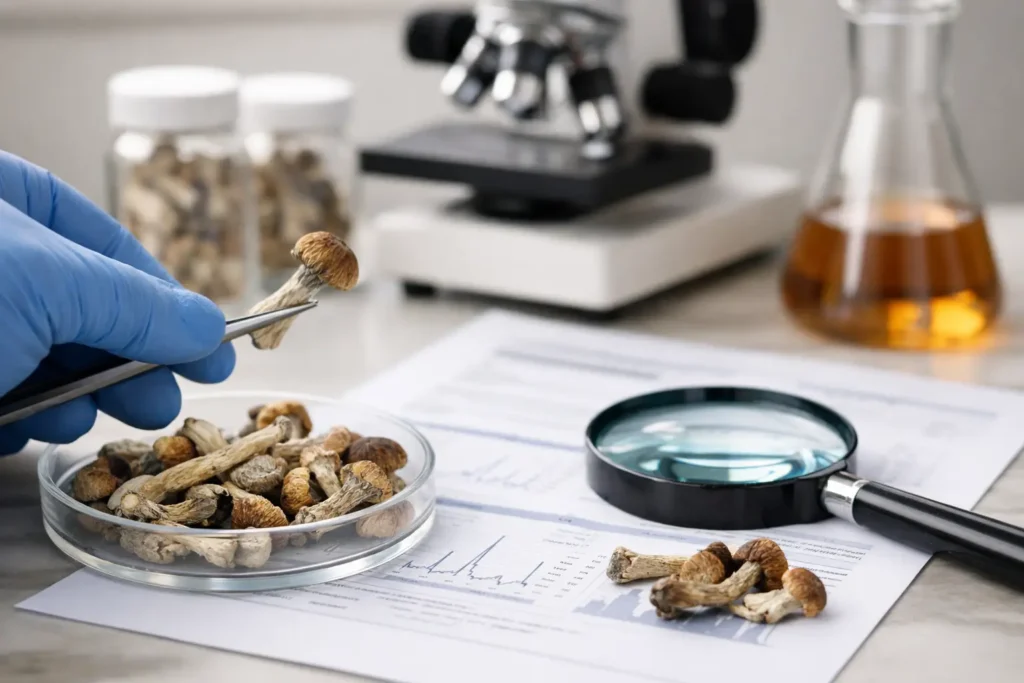
A polished label can tell you what a mushroom product is supposed to be. A certificate of analysis, or COA, is where you look for evidence. If you are asking what is a mushroom COA, the practical answer is simple: it is a lab document tied to a specific product or batch that reports what was tested and what the results showed.
For specialty mushroom buyers, that distinction matters. Wild-sourced dried caps, fruiting body powders, extracts, capsules, and blended wellness formulas do not carry the same quality considerations. A useful COA does not replace informed buying, but it gives you a clearer basis for evaluating identity, purity, and batch-level quality.
What Is a Mushroom COA?
A mushroom COA is a Certificate of Analysis issued after laboratory testing. It may be prepared by an independent third-party laboratory, an internal quality-control lab, or a supplier lab. The strongest documentation clearly identifies the testing laboratory, the product or lot number, the date, the testing methods, and the measured results.
The document is not one universal test. A COA can cover several different analyses depending on the material and the brand’s quality program. For example, a functional mushroom powder may be tested for heavy metals, microbial contamination, and marker compounds. A dried wild mushroom product may place greater emphasis on species identification, contaminant screening, and traceability.
The most useful question is not simply, “Does this product have a COA?” Ask: “Does this COA apply to the exact product and batch I am considering, and does it test for the risks and quality markers relevant to that material?”
Why a COA Matters for Mushroom Products
Mushrooms are biologically active materials, and their final composition can vary with species, growing conditions, substrate, harvest timing, processing, and storage. That is especially true for unmodified wild-foraged material. A COA creates a documented checkpoint between raw material and finished product.
For buyers, it can help confirm that a product is being handled with a defined quality standard rather than sold on appearance or general claims alone. This is valuable whether you are choosing a daily-use functional mushroom capsule or evaluating a specialty botanical product with naturally variable characteristics.
A COA also helps separate meaningful quality language from vague marketing. Terms such as “premium,” “pure,” and “lab tested” sound reassuring, but the report should show what was actually tested. A complete document gives you more than a badge. It gives you a record that can be reviewed.
What You May Find on a Mushroom COA
The content of a COA depends on the mushroom type and intended format. Not every test is relevant to every product, but several categories appear frequently.
Product and batch identification
Start with the basics. The document should name the product and identify a lot or batch number. That number should correspond with the packaging or the seller’s batch records. Without a matching lot number, a report may only show that some sample was tested at some point, not that your product was tested.
You may also see the sample type, date received, date tested, and report issue date. These details matter because a current test on a finished capsule is not equivalent to an old test on an unspecified raw ingredient.
Species identity
A COA may include identification by microscopy, DNA-based testing, botanical authentication, or another method appropriate to the material. For mushroom buyers, correct identification is foundational. “Mushroom blend” and “proprietary extract” are broad descriptions. A quality document should be more specific when species identity is central to the product.
Identity testing has limits. It can support that the submitted sample matches a stated species, but it does not automatically verify every quality attribute, every package in circulation, or the history of a wild-harvested specimen. Documentation and sourcing practices still matter.
Heavy metals
Mushrooms can absorb elements from their environment. Heavy-metal panels commonly screen for lead, arsenic, cadmium, and mercury. Results are usually shown in parts per million or milligrams per kilogram, alongside an established limit or pass/fail result.
A report that says “pass” is useful, but measured values offer more context. They show the actual result and make it easier to understand how the product performed against the laboratory’s stated specification.
Microbial testing
Microbial panels may check for total yeast and mold, total plate count, coliforms, E. coli, Salmonella, and Staphylococcus aureus. The exact panel varies based on the product format, processing method, and market requirements.
Dried mushrooms are lower in moisture than fresh mushrooms, but low moisture does not make testing irrelevant. Proper drying, packaging, storage, and handling all affect quality. A microbial result should be interpreted alongside the product’s shelf-life controls, not as a standalone guarantee.
Pesticides, mycotoxins, and residual solvents
Cultivated ingredients may be screened for pesticides. Certain products may also be tested for mycotoxins, which are compounds produced by some molds, or for residual solvents if an extraction process uses solvents. These tests are particularly relevant when the product is an extract, concentrated powder, or ingredient sourced through a multi-step processing chain.
The appropriate testing panel depends on how the mushroom was grown and processed. A one-size-fits-all COA is not automatically better. A relevant, transparent panel is.
Active compounds and potency markers
Functional mushroom extracts are often standardized to marker compounds such as beta-glucans, triterpenes, or other species-specific constituents. These figures can help a buyer compare products, but they need context.
A beta-glucan percentage, for instance, is not a universal measure of quality across every mushroom category. The extraction method, the part of the mushroom used, the testing method, and the product’s intended use all influence what the number means. It is also worth distinguishing beta-glucans from broad polysaccharide claims, which can be measured in different ways and may not communicate the same thing.
How to Read a Mushroom COA Without Getting Lost
You do not need laboratory training to spot the essentials. First, verify that the product name and lot number match. Next, look for the laboratory name, test date, and a clear result for each analysis. Then check whether the report lists an acceptable specification or limit next to the result.
Be careful with reports that provide only a generic statement such as “tested for purity.” Useful COAs identify the analytes tested, the result, the unit of measurement, and ideally the analytical method. A certificate with a signature but no batch information or actual results has limited value.
Also consider whether the COA is for the finished product. Testing an incoming raw powder is a meaningful quality-control step, but a finished capsule or blend can introduce additional variables through manufacturing and packaging. For a multi-ingredient product, the most relevant documentation may include both ingredient-level and finished-product testing.
COAs for Wild Amanita and Functional Mushrooms Are Not the Same
This is where category clarity matters. Wild Amanita products such as Amanita muscaria, Amanita pantherina, and Amanita regalis are raw botanical materials with natural variation in appearance and composition. A COA can support quality controls such as species verification and contaminant screening, but it does not turn a wild mushroom into a standardized supplement.
A functional mushroom extract or capsule is different. These products are typically processed and formulated for repeatable use, so standardized marker-compound testing and finished-product specifications may be more central to the quality conversation.
Neither category is inherently “better.” They serve different buyer preferences. Wild material prioritizes botanical authenticity and natural character. Standardized functional formats prioritize consistency, measured specifications, and routine-friendly use. A responsible seller should make that distinction clear rather than treating all mushroom products as interchangeable.
A COA also does not establish that a product is appropriate for every person, prove a specific effect, or override local regulations. It is a quality document, not a medical recommendation or a blanket safety certification.
Questions Worth Asking Before You Buy
If a product’s quality documentation is available, focus on relevance rather than volume. Does the COA match the batch? Was the material tested for contaminants that make sense for its source and format? Is the species or mushroom ingredient stated clearly? Are the results readable rather than hidden behind general claims?
For specialty mushrooms, sourcing information adds another layer. Ask whether material is wild-sourced or cultivated, whether it is raw or extracted, and whether it is sold as a dried botanical or a standardized functional product. Those answers help you interpret what the COA can tell you and what it cannot.
At Mario’s Mushrooms, clear category separation is part of making quality information useful. A buyer evaluating dried wild caps needs different expectations than someone selecting a functional powder or capsule for a consistent wellness routine.
A COA Is Evidence, Not a Shortcut
The best mushroom COA is specific, current, legible, and relevant to the product in front of you. It should support a broader quality picture that includes transparent product labeling, appropriate processing, careful storage, and clear category definitions.
When a seller can show what was tested, when it was tested, and which batch it applies to, you have a stronger foundation for an informed purchase. That is the real value of a COA: not a marketing phrase, but a practical record that helps you choose mushroom products with more clarity and control.