
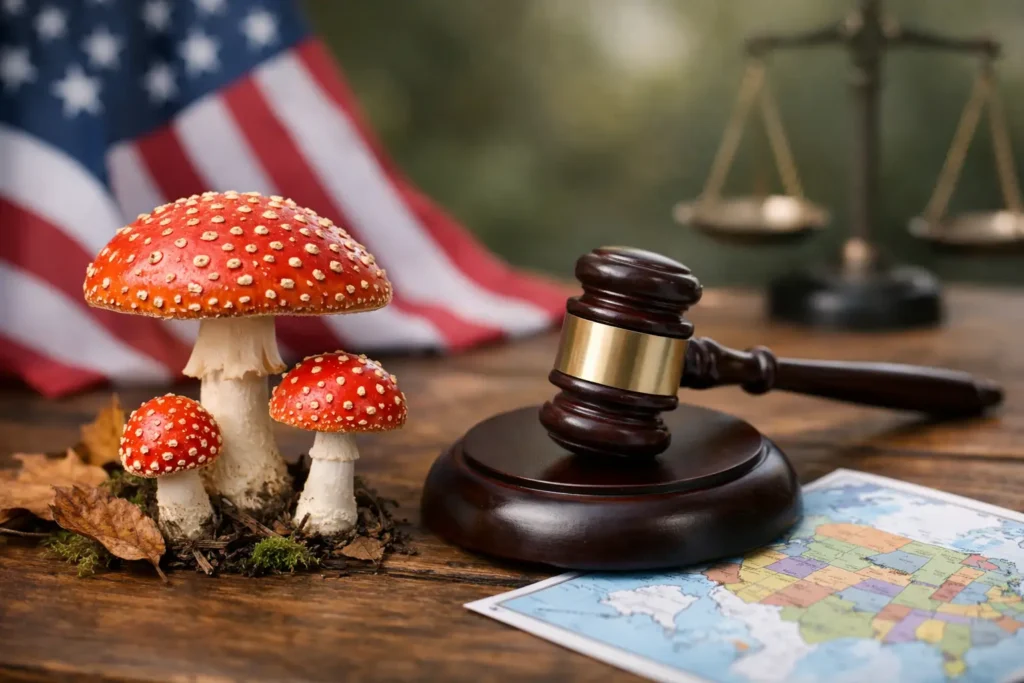
A specialty mushroom product can be available online and still be restricted where you live. That is the central point of this amanita product legality guide: legality is not determined by a product name alone. Species, jurisdiction, product format, intended use, and shipping destination can all affect whether an Amanita product may be possessed, purchased, sold, or imported.
For buyers interested in wild-sourced Amanita muscaria, Amanita pantherina, or Amanita regalis, the right approach is controlled and specific. Check the rules that apply to your exact destination before placing an order, and do not assume that a rule for one mushroom category applies to every product labeled as a mushroom.
Amanita Product Legality Guide: Start With the Species
“Amanita” is a large genus, not one legal category. It includes edible species, toxic species, and species sought by ethnobotanical collectors. The legal status of a product must be evaluated at the species level whenever possible.
Amanita muscaria, commonly recognized by its red or orange cap with pale warts, is generally not listed as a federally controlled substance in the United States. Its principal naturally occurring compounds are different from the substances found in psilocybin mushrooms. That distinction matters, but it is not a blanket authorization to buy, possess, sell, or ship every Amanita product everywhere.
Amanita pantherina and Amanita regalis also require separate consideration. They may be sold as wild botanical material in some markets, yet a jurisdiction can regulate a named species, a group of intoxicating plants or fungi, or products prepared for human consumption. A product page, a general web search, or an assumption based on Amanita muscaria does not replace a local rule check.
Species identification is also a quality issue. Wild mushrooms vary naturally in appearance and chemistry, and misidentification is a serious concern in any wild-foraged category. Buyers should expect clear botanical naming rather than broad or ambiguous descriptions.
Federal Status Is Only the First Check
In the United States, federal controlled-substance schedules are one reference point, not the complete legal answer. A mushroom may be absent from those schedules while still raising issues under state law, local ordinances, consumer-protection rules, or food and supplement regulations.
The Food and Drug Administration also regulates how products are marketed in interstate commerce. A dried wild mushroom cap, a powdered botanical, a capsule, and an edible can fall into very different practical categories. Claims matter. Once a product is presented as intended to diagnose, treat, cure, mitigate, or prevent a disease, it can create drug-regulatory concerns regardless of whether the underlying mushroom is scheduled.
That is why product classification should be clear. Raw, wild-sourced botanical material is not the same as a standardized functional mushroom powder made for a repeatable wellness routine. Functional products featuring species such as Lion’s Mane are typically positioned differently from dried Amanita caps, and buyers should not treat the two categories as interchangeable.
State and Local Rules Can Change the Answer
State law is often where Amanita legality becomes more specific. Some states and municipalities regulate certain psychoactive botanicals or fungi more broadly than federal law does. Others may have rules focused on possession, sale, preparation, advertising, or delivery.
Louisiana is frequently cited because its controlled dangerous substances law has provisions that can restrict certain hallucinogenic plants and fungi and specifically affects Amanita muscaria in ways that differ from many other states. The details of any statute, including exemptions and enforcement scope, matter. Treating a short social-media summary as a legal determination is not sufficient.
Local rules can matter as well. A city or county may adopt measures that affect entheogenic plants and fungi, though decriminalization policies are not the same as commercial authorization. A policy that changes enforcement priorities does not necessarily make retail sales, manufacturing, shipping, or public distribution lawful.
Before ordering, verify the current rules for the state and municipality where the product will be delivered. If you are traveling, remember that the rules at your destination may differ from the rules where you purchased the product.
Product Format and Marketing Matter
A dried cap is not legally identical to every product that can be made from that cap. Processing can change both the regulatory analysis and the risk profile. Extracts, gummies, beverages, tinctures, blends, and capsules may attract additional scrutiny because they can be marketed as foods, supplements, or consumer packaged goods.
For Amanita products in particular, buyers should be cautious around vague formulas. A label that uses generic language such as “proprietary mushroom blend” without identifying the species, plant part or fruiting body, serving format, and intended category leaves too much unanswered.
Clear product segmentation is useful for both compliance and informed purchasing. Wild botanical material should be described as such. Standardized functional mushroom products should identify their format and ingredients. These distinctions help a customer assess what is being offered rather than relying on broad “mushroom” terminology.
Avoid treating product claims as proof of legality. Statements about mood, altered states, sleep, pain, or medical outcomes may signal a marketing approach that creates regulatory risk. They are also not a substitute for professional medical advice or product-specific safety information.
Shipping Is a Separate Compliance Question
Online availability does not mean a seller can ship a product to every address. Responsible retailers review shipping restrictions, but the buyer still has a role in confirming that an item is permitted in the delivery location.
Domestic shipping is generally simpler than cross-border shipping, but it is not automatically uncomplicated. State restrictions can apply at the destination. Shipping across the U.S.-Canada border adds a separate layer involving customs, import rules, product classification, declarations, and the receiving country’s requirements.
Canadian buyers should not rely on U.S. federal scheduling information, and U.S. buyers should not assume Canadian retail availability answers a U.S. legal question. Canada has its own federal and provincial frameworks for controlled substances, natural health products, foods, and imports. The status of a raw mushroom, a packaged edible, and a wellness capsule may differ significantly.
Never ask a seller to mislabel a package, alter a declaration, or ship to a location where the item is restricted. Those requests create unnecessary risk for both parties and undermine the transparent purchasing standards that specialty botanical products require.
A Practical Pre-Purchase Check
A careful legality review does not need to be complicated, but it should be deliberate. Start by confirming the full botanical name of the product. Next, check your state and local rules for that named species and for the product’s actual format. Then review whether the seller identifies destination restrictions or declines shipments to certain areas.
If a rule is unclear, read the current statutory language and contact a qualified attorney or the relevant state or local agency. This is especially worthwhile when you plan to import a product, travel with it, purchase larger quantities, or use it in connection with a business.
Keep the question narrow when you research it: “Is possession of dried Amanita muscaria caps permitted at my delivery address?” is more useful than “Are Amanitas legal?” Broad searches often produce outdated pages, commentary from another country, or information about psilocybin mushrooms that does not apply.
Legality Does Not Equal Suitability
A product can be legal in a particular jurisdiction and still be unsuitable for a particular person or use. Amanita species are not casual culinary mushrooms, and naturally occurring compounds can vary by species, source material, handling, and preparation. Raw wild material should be approached with more caution than a conventional, clearly labeled functional mushroom supplement.
Do not use specialty mushroom products if you are unable to make an informed decision about their identity, legal status, or safety considerations. Keep them away from children and pets, avoid combining them with alcohol or other substances, and speak with a qualified healthcare professional about potential medication interactions or personal health concerns.
The strongest purchase decision is a documented one: the correct species, a clearly described format, a permitted destination, and a retailer that treats botanical specificity as a standard rather than an afterthought. That clarity protects the buyer and preserves the credibility of the specialty mushroom category.