
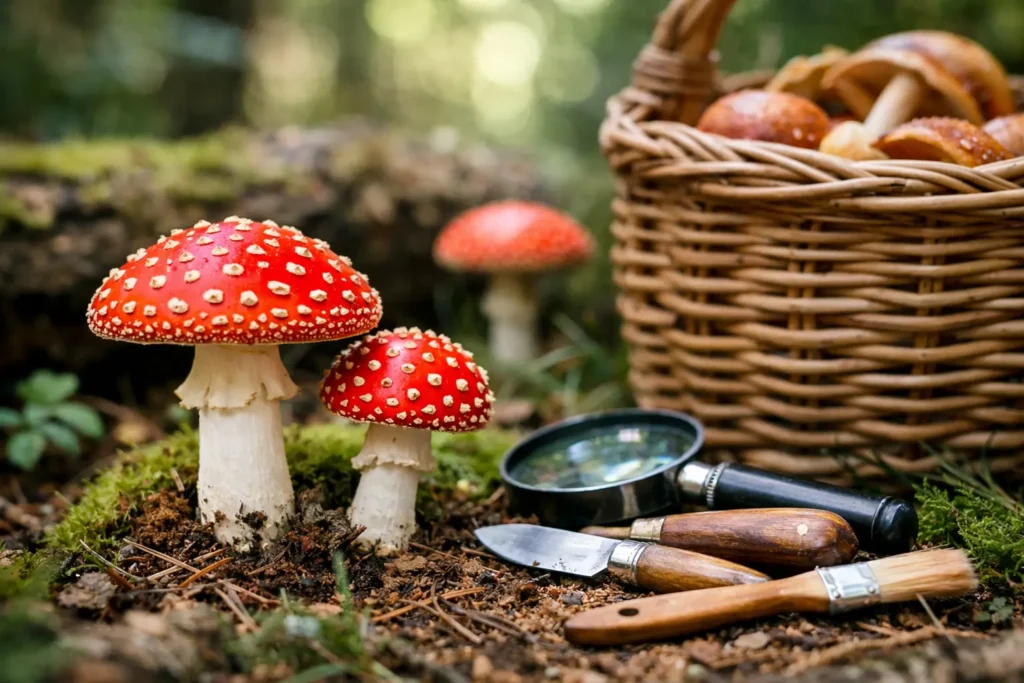
A red cap with white veil remnants can look like the obvious starting point, but amanita for botanical collecting requires more discipline than a quick visual match. Amanita is a diverse genus with look-alikes, variable field appearance, and species that can be dangerously toxic. A worthwhile collection begins with documentation, provenance, and a clear rule: a botanical specimen is not automatically a food item or a wellness product.
Why Amanita Demands a Different Standard
Collectors are often drawn to Amanita because the genus is visually distinctive and culturally recognizable. Amanita muscaria, pantherina, and regalis can present striking caps, but appearance changes with weather, age, handling, region, and the loss of universal-veil material. A cap that looked highly characteristic in the field may look very different after transport or drying.
That variability is exactly why broad labels and single-photo identification are weak collecting practices. Amanita identification can depend on a complete set of features: cap surface, gills, stem, ring, bulb structure, volva or veil remnants, bruising or color change, habitat, nearby tree species, season, and geographic range. Missing one detail can turn a confident name into an unreliable assumption.
The practical standard is simple. Treat every Amanita specimen as potentially hazardous until its identity has been assessed using multiple features and, where needed, reviewed by an experienced local identifier. Never taste a specimen, and do not use smell, an app result, or an online image as proof of identity.
Start With a Collection Purpose
Botanical collecting is more useful when the purpose is defined before a specimen is picked. A field voucher supports identification and ecological records. A photographic collection documents morphology in place. A legally acquired dried specimen may be kept for visual study, comparison, or educational display. These are related activities, but they are not interchangeable.
For a field voucher, the goal is to preserve information that may be impossible to recover later. For a display specimen, visual integrity and secure storage matter more. For someone comparing wild Amanita material with standardized functional mushroom products, the key distinction is category clarity: raw, wild-sourced material retains natural variation, while processed functional formats are designed around repeatable use and consistency. One should not be represented as the other.
This distinction also prevents a common mistake. A dried cap is not a verified species record merely because it has a familiar appearance. Without source details, collection context, and a reliable chain of identification, it may be appropriate as a botanical object, but not as definitive evidence of a species occurring in a particular location.
Field Documentation Before Handling
Photograph the mushroom where it grows before removing it. Capture the cap from above, the side profile, gills, full stem, base, surrounding ground cover, and nearby trees. Include a scale reference without placing unrelated objects directly on the specimen. Photographing several growth stages can be especially valuable because young buttons and mature caps may reveal different diagnostic features.
Record the date, general location, habitat, substrate, weather conditions, and associated plants or trees. Exact coordinates are useful for a private field log, though sensitive sites should not be broadly shared. Notes such as “under mixed conifers” are better than no habitat record, but a more precise observation is stronger: which trees were closest, whether the soil was sandy or rich, and whether the mushrooms were solitary or growing in a group.
When collecting a specimen for identification, remove it carefully enough to preserve the entire base. Many Amanita traits occur at the bulb and volva, which can remain underground if a mushroom is simply cut at the stem. A small digging tool is preferable to pulling. Keep specimens from different locations in separate paper containers and label them immediately. Mixing mushrooms in one bag creates an avoidable identification problem and can damage fragile features.
What Not to Do
Avoid plastic storage for fresh specimens when possible. It traps moisture, speeds deterioration, and can turn clear field traits into a soft, indistinct mass. Do not wash specimens before documentation, as surface remnants can matter. Do not handle an unknown Amanita and then touch food, your face, or other items without washing your hands.
Most importantly, do not collect with an assumption of consumption. Some Amanita species contain compounds associated with serious poisoning, including potentially fatal toxicity. Botanical interest does not reduce that risk.
Preserving a Useful Botanical Specimen
A specimen intended for long-term keeping needs a label that stays with it. At minimum, include a collection number, tentative identification, date, region, habitat notes, and the name or initials of the collector. Your collection number should connect the physical specimen to photos and field notes. This is what turns a dried mushroom into a usable record rather than an anonymous object.
Drying must be thorough if a specimen is being retained. Residual moisture invites mold, insects, and decay, while excessive heat can darken or distort features. The objective is stable preservation, not cosmetic perfection. Once dry, keep the specimen in a clearly labeled, sealed container away from children, pets, food, and routine household supplies.
For valuable records, include a small label inside the container as well as one on the outside. External labels can fade, peel, or become separated during storage. A duplicate paper record is low effort and protects the collection’s long-term value.
If a specimen is acquired rather than field-collected, retain the original product information, lot details when available, and the date received. This is particularly relevant for specialty dried caps, where geographic origin and product category can be meaningful context. Responsible sellers should describe material plainly and avoid blurring the line between wild botanical specimens and standardized supplement products.
Identification Is a Process, Not a Caption
A tentative name is acceptable in a personal collection when it is marked as tentative. Writing “Amanita species” or “cf. Amanita muscaria” is more accurate than assigning a precise species name without adequate evidence. The notation reflects uncertainty instead of hiding it.
Regional variation matters. A species description developed for one part of North America may not map cleanly onto another region, and names used casually in commerce or hobby discussions may not reflect current taxonomy. Expert review, regional field resources, and microscopy or DNA work can all improve confidence, but each has limits. DNA results, for example, are only as useful as the reference data and sample handling behind them.
For collectors in the United States and Canada, local rules also matter. National parks, protected lands, private property, and municipal areas can have different restrictions on removing fungi. Permission is not a formality. It protects habitats, respects landowners, and helps keep collecting practices credible.
Building a Collection With Clear Boundaries
The best Amanita collections are curated, not accumulated. A smaller group of well-labeled specimens with strong photographs and habitat notes is more useful than a box of unidentified caps. Focus on documentation quality, provenance, and storage stability. Those standards also make it easier to revisit an identification later when better references or expert input become available.
Keep wild specimens physically and conceptually separate from functional mushroom products. Lion’s Mane powders and capsules, for example, belong to a different product logic: measured formats, defined ingredients, and regular-use convenience. Wild Amanita caps belong to the botanical and ethnomycological side of a collection, where natural variation, field context, and caution are central.
Amanita rewards close attention, but it does not reward shortcuts. Label what you know, preserve what you can verify, and let uncertainty remain visible when the evidence is incomplete. That is how a striking mushroom becomes a collection worth keeping.