
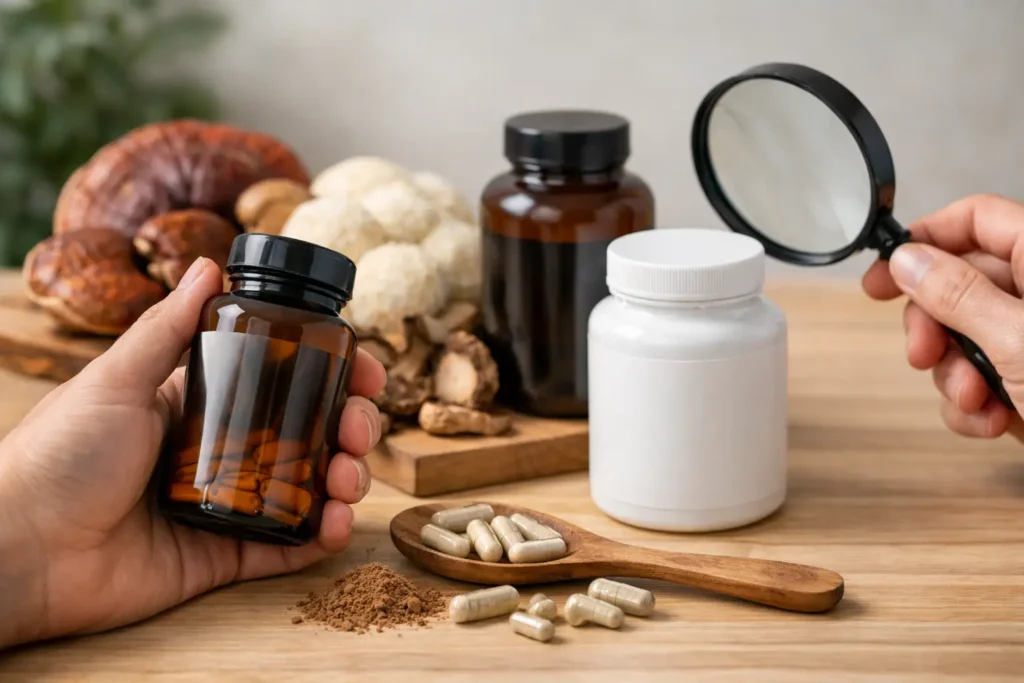
A mushroom supplement label can look impressive while telling you very little about what is actually in the capsule or powder. A large front-label number, a dramatic mushroom image, and terms such as “full spectrum” may catch attention, but they do not replace basic product details. Knowing how to read mushroom supplement labels gives you a more reliable way to compare products based on species, source material, extraction, and measurable quality markers.
For functional mushrooms, the goal is not to find the longest list of benefits. It is to identify a product whose label clearly explains what was used, how it was processed, and how much you receive per serving. A well-built label supports a repeatable routine. A vague one leaves too much to guesswork.
Start With the Exact Mushroom Species
The common name is only the beginning. “Lion’s Mane,” for example, should be identified as Hericium erinaceus. Reishi should be identified as Ganoderma species, ideally with the specific species named. Turkey Tail should identify Trametes versicolor.
This matters because mushroom names can be used loosely in supplement marketing. A label that names the botanical species shows greater product control than one that simply says “mushroom blend.” Species identification also helps you compare like with like. You cannot meaningfully compare two Lion’s Mane products if one does not clearly confirm that Lion’s Mane is what it contains.
Blends are not automatically a problem. A blend can be useful when it lists each species and the amount of each one. The concern is a proprietary blend that provides one total weight for several mushrooms without showing their individual amounts. If a blend contains 2,000 mg of six mushrooms, there is no way to know whether the mushroom you want is present in a meaningful quantity.
Check Whether It Uses Fruiting Body, Mycelium, or Both
One of the most useful parts of learning how to read mushroom supplement labels is recognizing the difference between fruiting body and mycelium.
The fruiting body is the visible mushroom structure – the cap, stem, and other mature fungal material. It is commonly dried, milled into powder, or extracted for capsules and tincture-style products. Many customers prefer fruiting body products because the label provides a direct connection to the recognizable mushroom material.
Mycelium is the root-like network of fungal growth. It can be cultivated on a substrate such as grain, then processed into powder. Mycelium-based products are not inherently low quality, but they should be labeled clearly. The key question is whether the finished material is mostly fungal biomass, or whether it includes a substantial amount of the grain substrate on which it was grown.
Look for straightforward language such as “100% fruiting body,” “fruiting body extract,” “mycelium biomass,” or “mycelium on grain.” If the label only says “mushroom powder,” the source material remains unclear. That does not always mean the product is poor, but it makes a confident comparison harder.
Understand Powder Versus Extract
A mushroom powder is usually dried material that has been ground. It may be a practical choice for people who want a simple, minimally processed format. An extract is processed to make certain compounds more available or concentrated, often using hot water, alcohol, or a combination of methods.
Neither format is automatically better. It depends on the species, your intended use, and whether the manufacturer is transparent about the process. A plain fruiting body powder may appeal to buyers who want a close-to-whole-food mushroom format. A standardized extract may be a better fit for someone who values consistency from one container to the next.
For extracts, look for language that identifies the extraction method or the extract ratio. A 10:1 extract means that a stated amount of extract was produced from a larger amount of starting material. However, extract ratios alone can be misleading. They do not tell you which compounds are present or whether the final material has been tested. A clearly stated beta-glucan level is generally more useful than an extract ratio printed without further context.
Read Beta-Glucan Claims Carefully
Beta-glucans are naturally occurring polysaccharides found in many mushrooms. They are one of the most common quality markers on functional mushroom labels, particularly for extracts. A brand may list beta-glucans as a percentage, such as “minimum 20% beta-glucans,” or provide an amount per serving.
Specificity matters. “Polysaccharides” is a broader category than beta-glucans. It can include starches and other carbohydrates, especially in products made with grain-grown mycelium. A label that only highlights total polysaccharides does not give the same level of detail as one that identifies beta-glucans directly.
Do not treat the highest percentage as an automatic winner, either. The number should make sense alongside the serving size, species, and product type. A high beta-glucan percentage in a very small serving may provide less material than a moderate percentage in a larger serving. Compare the full panel, not one claim in isolation.
Confirm the Serving Size and Actual Amount
The front of a container may say “2,000 mg,” but that figure can refer to several capsules, a full scoop, or even a multi-ingredient blend. Turn the package over and review the Supplement Facts panel.
Check the serving size first, then the amount of each mushroom ingredient per serving. If the container has 60 capsules but each serving is two capsules, it provides 30 servings. That affects both daily cost and convenience.
Also watch for products that list an impressive amount of raw-material equivalent instead of the actual extract amount. For example, a label may promote “5,000 mg equivalent” while the serving contains 500 mg of extract. This can be a legitimate way to describe an extract, but the actual amount in the capsule should still be stated clearly. Transparent labels show both when relevant, rather than relying on the bigger number alone.
Review the Other Ingredients
Capsules need a shell, and powders may need a flow agent or flavor component. A short list of inactive ingredients is not necessarily a concern. The point is to know what they are and why they are there.
Look for the capsule material, such as vegetable cellulose or gelatin, along with any fillers, sweeteners, gums, or flavor systems. If you are choosing a single-species mushroom powder, the ingredient list should not be unexpectedly complicated. In a flavored drink mix, additional ingredients are more expected, but they should still be easy to identify.
Allergen statements deserve attention as well. Manufacturing facilities may handle common allergens, and mycelium products cultivated on grain can be especially relevant for people with grain sensitivities. The label should give you enough information to make a practical decision rather than requiring assumptions.
Look for Testing and Traceability Signals
A quality mushroom supplement should be supported by more than polished packaging. Labels may reference third-party testing, lot numbers, country of origin, or testing for heavy metals and microbial contaminants. These details signal that the manufacturer is treating the product as a controlled botanical material rather than a generic commodity.
A lot or batch number is particularly useful because it connects a container to a specific production run. Testing claims are stronger when the brand can identify what it tests for, such as identity, microbial quality, heavy metals, or active compounds. Broad statements like “lab tested” are a start, but they are less informative without any indication of scope.
Wild-sourced mushrooms require a different label mindset. A dried wild mushroom cap is not the same type of product as a standardized functional capsule. Its value may be tied to species identity, sourcing, appearance, and natural variation rather than a uniform beta-glucan target. Product categories should be kept clear. Specialty ethnobotanical material and routine functional mushroom supplements are distinct formats with different expectations for use, consistency, and labeling.
Red Flags Worth Noticing
Some labels make comparison difficult by design. Be cautious when a product does not identify the mushroom species, hides amounts inside a proprietary blend, or relies on broad claims without naming its source material. The same applies when a product uses “extract” prominently but provides no extraction details, standardization information, or testing context.
Be equally cautious of labels that promise dramatic outcomes. Functional mushroom supplements should be presented as botanical products, not as replacements for medical care or guaranteed solutions. A professional label stays specific about ingredients and avoids making the container do more talking than the product data can support.
A strong purchase decision starts with a simple standard: you should be able to identify the species, material type, format, serving amount, and quality controls without having to decode marketing language. When a label answers those questions clearly, it gives you a practical foundation for choosing a mushroom product that fits your preferences and routine.